
Phoenix Metro
Swamp Cooler Repair in Phoenix.
- (520) 556-8929
- Serving the entire Phoenix metro — we come to you
- Office: Mon–Fri 8:00 AM – 5:00 PM · 24/7 emergency service
- 2-year workmanship warranty · 1-year parts warranty
- Veteran-owned & operated · residential + commercial
- 23 five-star Google reviews
Residential HVAC across the Valley.
Air conditioning, heating, and cooler work at homes across the Phoenix metro.
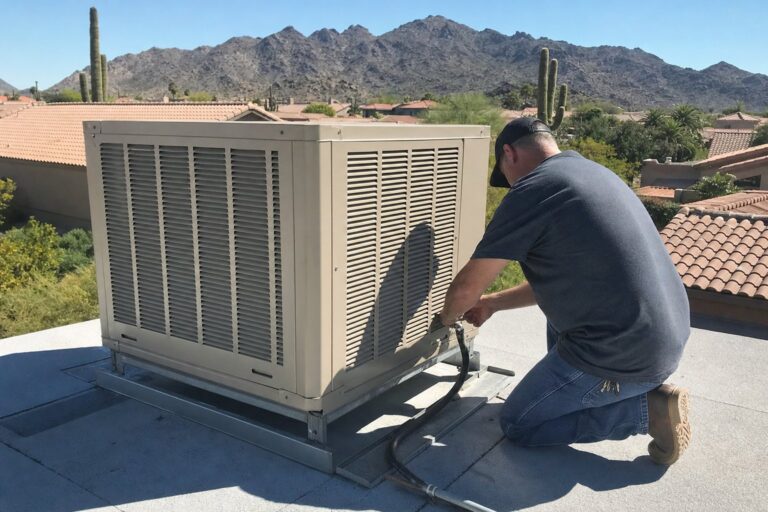
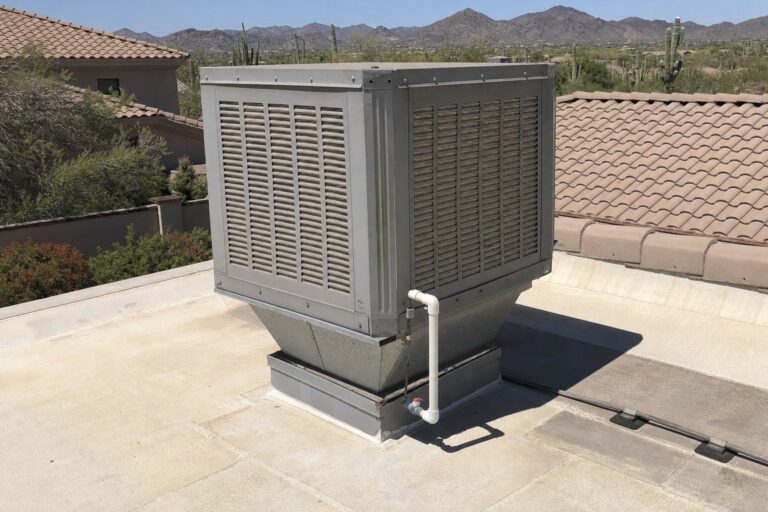
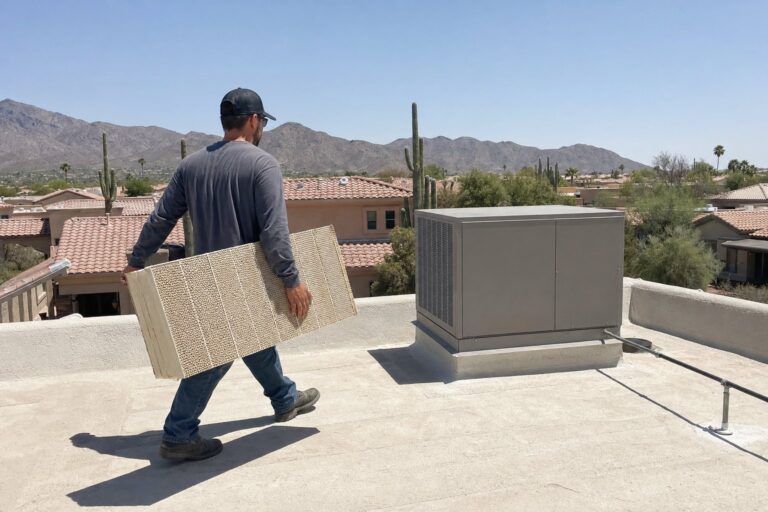
Phoenix never completely gave up the swamp cooler, and for several months of the year it has no reason to. Evaporative coolers still ride the rooflines of the Valley’s older neighborhoods — central Phoenix bungalows, Glendale and Mesa ranch homes, workshops, and detached garages — pushing out cold air for a fraction of what a compressor costs to run. Finding someone who still works on them is the hard part. Yeti Pros provides swamp cooler repair across the entire Phoenix metro: veteran-owned and operated, licensed under ROC #363372 · ROC #363423, with flat-rate written quotes and a real person answering the phone 24/7. Call (520) 556-8929.
The Valley still runs one of the country’s biggest evaporative-cooler fleets
Drive the older grid streets of Phoenix, Glendale, Mesa, or Tempe and count rooftops — evap coolers are everywhere once you start looking. They cool historic-district bungalows, mid-century ranch homes, workshops, garages converted into gyms and hobby spaces, barns and outbuildings on county lots, and plenty of primary residences whose owners have done the utility math and like the answer. The equipment isn’t the problem — most HVAC companies simply walked away from evaporative service years ago, steering every call toward refrigerated replacement. We didn’t. If it has pads, a pump, and a blower, we work on it — including Mastercool-style rigid-media coolers and conventional Aerocool-style side-draft and down-draft cabinets.
What a repair visit looks like — and how pricing works
You call, a human answers, and you learn the exact service-call fee before anything gets scheduled; that fee is credited toward the repair.
On the roof, the tech diagnoses the cooler, shows you what failed, and hands you a flat-rate quote in writing before work begins.
Every job is backed by our written warranty, which goes beyond the Minimum Workmanship Standards Arizona’s ROC sets as the legal floor for licensed contractors.
Military families and veterans always take 10% off — we’re veteran-owned, so that one is personal. Swamp cooler work is part of our full residential HVAC lineup, and we run the whole metro: Phoenix, Scottsdale, Mesa, Chandler, Gilbert, Glendale, Tempe, Peoria, Surprise, Goodyear, Avondale, Buckeye, Queen Creek, San Tan Valley, Apache Junction, Sun City, Sun City West, Fountain Hills, Paradise Valley, Anthem, Cave Creek, Maricopa, and Casa Grande.
Why evaporative cooling thrives here — until the monsoon shows up
A swamp cooler is simple physics: a blower pulls hot outdoor air through water-soaked pads, the water evaporates, and evaporation strips heat from the airstream. The drier the incoming air, the more heat it surrenders. In April, May, and June — when Valley afternoon humidity often falls into the single digits — a healthy cooler can knock supply air down by twenty degrees or more while drawing a small fraction of the electricity a refrigerated system needs.
Now the honest part that sales pitches skip. When monsoon moisture arrives from late June through September, the same physics turns against you: humid air can’t absorb much more water, so the temperature drop shrinks and the house starts feeling damp instead of cool. A cooler that performed beautifully in early June isn’t broken in August — it’s fighting a dew point it cannot beat. Part of our job is telling you which situation you’re in — we won’t sell repairs to a machine that’s working correctly.
Common swamp cooler repairs in Phoenix homes
Valley water and Valley heat wear on evaporative equipment in predictable ways. Here’s what we fix most often:
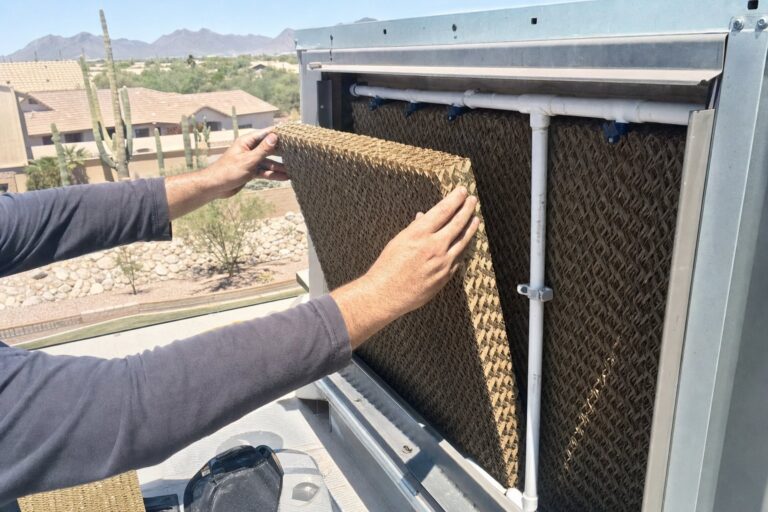
Aspen pads generally want replacement every season; rigid media lasts longer but still crusts over. Once pads mat up with mineral scale, airflow drops and cooling drops with it.
The little recirculating pump is the workhorse of the whole machine, and hard-water scale eats impellers. If the blower runs but the air is warm and the pads are dry, the pump is suspect number one.
A stuck float either starves the reservoir or overfills it and sends water sheeting down your fascia and stucco. Cheap part, expensive consequences when ignored.
Squealing at start-up, glazing, cracking, thrown belts — belt-drive coolers need tension and alignment checked every single season.
Dry bearings grind and seize, and motors don’t live gentle lives on a Phoenix roof. We lubricate serviceable bearings, replace worn ones, and swap motors that test weak before they strand you in June.
Sun-rotted poly tubing splits, fittings weep, and a slow rooftop leak can quietly ruin roofing and the ceiling below it.
The bleed-off line exists to dump mineral-heavy water before it concentrates in the reservoir. When it clogs — or was never set up properly — scale accelerates through the entire cabinet.
Phoenix water is famously hard, and every gallon a cooler evaporates leaves its minerals behind. We descale reservoirs, clear distribution troughs and spider tubes, and treat cabinets before rust wins the argument.
Spring start-up and fall winterization: the two visits that prevent most breakdowns
The majority of mid-summer evap failures we see trace straight back to skipped seasonal service, which is why we run both visits as standing services across the metro.
Spring Start-up
fresh pads, reservoir descale and cleanout, pump and float check, belt tension and bearing lubrication, water-line inspection, bleed-off verification, and a full wet-run test — so the first 100° day isn’t the test. Book it in March or April, ahead of the rush that arrives with the first hot week.
Fall Winterization
water supply off, lines drained (hard freezes are rare in the Valley but real, especially on the outskirts), reservoir emptied and cleaned, damper closed or cover installed so your winter furnace heat doesn’t pour out through the cooler, and a short condition report telling you what next spring will need.
The two-system home: evap in the dry months, AC when it’s muggy
Plenty of Valley houses run both a swamp cooler and refrigerated air, and used deliberately, that pairing is a genuine bill-cutter. Evaporative cooling carries April through June and again in October at low operating cost; the AC takes the humid monsoon core when evap output collapses. On APS and SRP time-of-use and demand plans, keeping the compressor off through the long dry shoulder seasons is real money. The catch is coordination — dampers and controls have to be set up so the two systems don’t fight each other, and neither machine tolerates being ignored all year. We service both halves of a hybrid home: the cooler through this service, the refrigerated side through AC repair and seasonal AC maintenance.
Repair it, or convert to refrigerated air? Straight answers
Keep the Cooler When…
the space suits it — a garage, shop, or well-ventilated older home — and you can live with reduced performance during the humid weeks.
Consider Conversion When…
you need dependable cooling all summer, someone in the household is heat-sensitive, you’re done with seasonal upkeep, or the cabinet and its ducting are at end of life anyway. Conversion is a real project, not a swap: evap ductwork is oversized for refrigerated airflow and usually needs rework, the house needs a proper load calculation, and the electrical panel often needs attention. Our AC installation page covers how we run that job, and ductwork installation covers the duct side; all refrigerant work is performed by EPA 608 certified technicians.
And when the honest answer is “your cooler has years left in it,” that’s exactly what you’ll hear.
Swamp cooler questions Phoenix homeowners ask us
Why is my swamp cooler blowing warm air?
Check three things in order: is the pump running (pads should be visibly wet), are the pads scaled over or dry in patches, and is the water supply on with the float admitting water? A dead pump or dry pads explain most warm-air calls. If all three check out and it’s a muggy August afternoon, the cooler may simply be at its physical limit — humidity is the one thing evaporative cooling can’t fight.
Why does my cooler smell musty?
Stale reservoir water, algae, or pads overdue for replacement. A cleanout, new pads, and a properly working bleed-off line cure it in nearly every case. If the odor appears right at spring start-up, the cooler was probably shut down wet last fall.
How often do pads really need changing?
Aspen pads: every season, sometimes mid-season given our water hardness. Rigid media in Mastercool-style units: several seasons if the bleed-off is doing its job, but it still needs annual inspection and cleaning. Scaled-over pads are the single biggest performance killer we find on Valley roofs.
Do swamp coolers use a lot of water?
They use meaningful water — evaporation is literally how they cool — plus the bleed-off. Consumption depends on unit size, runtime, and setup. The trade is water for electricity: a cooler’s motor and pump draw far less power than a compressor. Whether the trade favors you depends on your rates, and we’ll talk it through without spin.
Can you service a cooler on a steep or two-story roof?
Yes. Roof-mounted coolers are most of what we touch, and safe access — proper ladder work, careful footing on hot tile and foam, weather timing — is part of the trade. If a mount, roof jack, or curb is deteriorating, we flag it before it becomes a roof leak.
Is it worth fixing an old cooler, or should I just convert?
If the cabinet is structurally sound, most repairs are inexpensive relative to conversion and well worth making. If it’s rusted through, or you need cooling that holds up in monsoon humidity, we’ll quote the conversion honestly instead — see the guidance above.
Do you only fix breakdowns, or do start-ups and shutdowns too?
Both. Spring start-ups and fall winterizations are standing services, and they prevent most of the failures listed on this page.
Cooler down — or due for its spring start-up? Call (520) 556-8929 and get a veteran-owned crew that still takes swamp coolers seriously.
Permits and inspections
Most repairs are ordinary service work; bigger scopes can involve city permitting. We perform our work to code, pull the permits our scope requires, and put what we did in writing.
What's covered
Workmanship is covered for two full years, in writing, and repair parts carry a 1-year manufacturer parts warranty — we document installs and repairs so those claims stay simple to make
Why a licensed HVAC contractor matters.
Related specialty services.
Swamp Cooler Repair in Phoenix, city by city.
Every city below has its own local page for this service — local FAQs, utility territory, housing stock, and dispatch reality included.
Every major brand, serviced and installed.




Phoenix metro: Most days a tech is already working somewhere in the Valley, so same-day appointments happen when the schedule allows. After-hours emergencies are dispatched when a licensed tech is available — a real person answers and tells you the ETA on the call.
Call (520) 556-8929Request an estimate.
No pressure, no door knockers. We look at the HVAC system, tell you what it needs (and what it doesn’t), and put the number in writing.