
Phoenix Metro
AC Maintenance in Phoenix.
- (520) 556-8929
- Serving the entire Phoenix metro — we come to you
- Office: Mon–Fri 8:00 AM – 5:00 PM · 24/7 emergency service
- 2-year workmanship warranty · 1-year parts warranty
- Veteran-owned & operated · residential + commercial
- 23 five-star Google reviews
Residential HVAC across the Valley.
Air conditioning, heating, and cooler work at homes across the Phoenix metro.
In most of the country, skipping AC maintenance is a gamble you’ll probably win. In Phoenix it’s a gamble you’ll eventually lose in the worst week of the year, standing in a 95° living room, calling contractors who are all booked three days out. Yeti Pros runs AC maintenance and tune-ups across the entire Phoenix metro. Veteran-owned, ROC #363372 · #363423. Call (520) 556-8929.
A Valley air conditioner works triple the annual runtime of a system in a mild climate — maintenance here isn’t upsell fluff, it’s how you decide when your system gets attention: on a pleasant March morning at planned prices, or during the first 113° week at emergency prices.
What a real tune-up covers (and what a $29 coupon doesn’t)
You’ve seen the deep-discount tune-up coupons. Understand what they usually are: a lead-generation visit where someone hoses the condenser, eyeballs the filter, and spends the remaining time building a scary quote. A real maintenance visit is measurement-driven — numbers on paper, compared to spec and to last year. Ours covers:
Measured not glanced at. Capacitor microfarads against rating (the #1 Phoenix summer failure announces itself here months early), contactor contact condition, motor amp draws against nameplate, wiring and disconnect inspection, voltage checks.
Pressures and superheat/subcooling readings, temperature split across the coil, and line-set inspection. Readings that drift year-over-year expose slow leaks long before the system stops cooling.
Condenser coil cleaned of the dust and cottonwood the Valley packs into it; evaporator coil inspected for fouling and biological growth.
Phoenix’s sneakiest failure. Drain line flushed, float switch tested, pan inspected. Bone-dry all spring, these clog exactly when monsoon humidity arrives, shutting the system down or overflowing through a ceiling.
Filter checked, blower wheel condition, static pressure where warranted, thermostat calibration and program review.
Every reading documented, graded, and compared to last visit — so “your capacitor is weakening” is a trend line you can see, not a stranger’s opinion you have to take on faith.
The economics, without the brochure gloss
Three ways maintenance pays for itself in this specific market:
The catastrophic July failure is usually a cheap part that had been dying since April — a $30 capacitor that finally took the compressor’s start circuit with it, a slow leak that finally iced the coil. Caught at tune-up, these are minor line items. Caught at 6 p.m. in a heat wave, they’re emergencies with queue time.
A dust-fouled coil and a low charge quietly add double-digit percentages to the electricity your system burns per hour of cooling — and Phoenix hands you more of those hours than anywhere. On summer APS/SRP bills, a well-maintained system versus a neglected one is a visible monthly difference.
Manufacturer parts warranties expect documented maintenance; a service history in your folder means no awkward conversations at claim time. And in a climate that already compresses system lifespans to 10–15 years, maintenance is the main lever that pushes you toward the far end instead of the near one.
When to schedule what
The cooling tune-up. The one that matters most, done before the first heat wave — because the first 110° week is when every neglected system in the Valley fails simultaneously and the whole industry books out.
The heating check. Heat pumps get their heating-mode components verified (reversing valve, defrost, auxiliary strips); gas furnaces get burners, ignition, and heat-exchanger inspection — that last one is a carbon-monoxide safety item, not a comfort item. Details on the heating page.
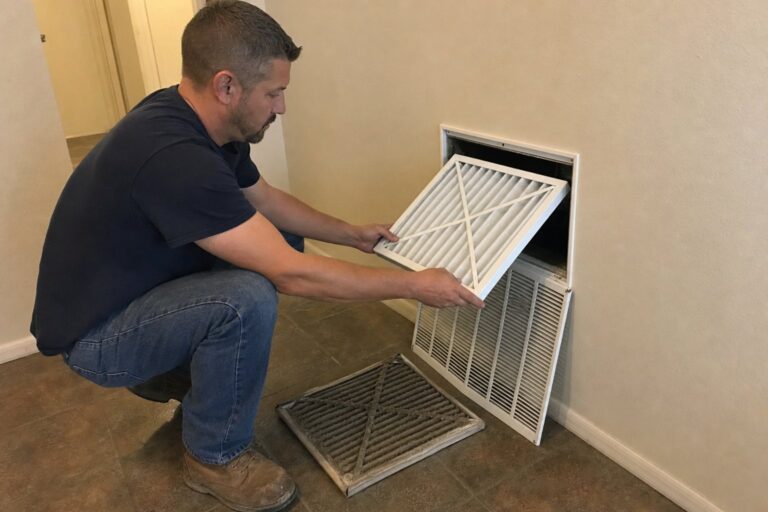
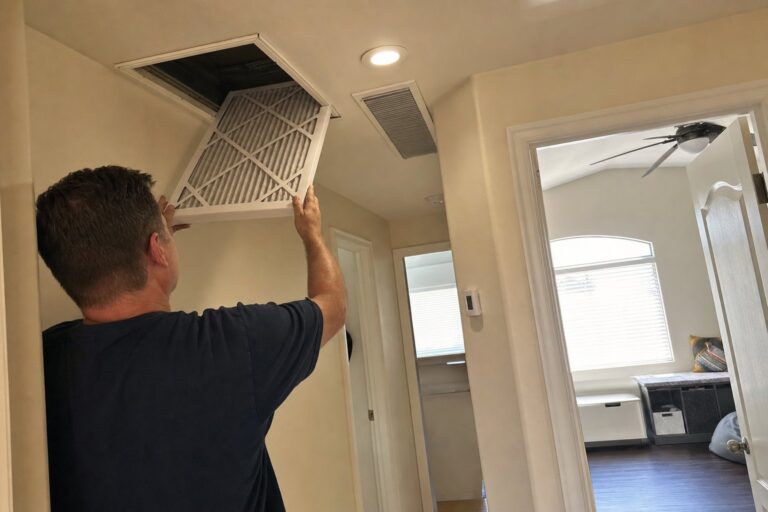
The filter. The single highest-value maintenance act in Phoenix is free minus the filter cost. Summer dust loads clog filters in weeks; a suffocated system loses capacity and ices coils. We’ll show you the right filter and the 30-second swap.
The maintenance plan: how the smart money does it
Our plan members get both seasonal visits scheduled automatically (we call you — the system never goes un-checked because life got busy), priority dispatch when something does break (front of the queue during heat waves, which is when queues matter), preferred pricing on repairs, and the full written condition report after every visit. For military families, the 10% discount applies to the plan too — which makes it, honestly, the best dollars-to-protection ratio we sell. No auto-renewal traps, no cancellation fees, no fine print designed to outsmart you; it’s a service agreement, not a gym membership.
What we’ll never do at a tune-up
The maintenance visit is where this industry earns its reputation, good or bad. Our rules: we don’t invent failing parts (readings are shown, not narrated), we don’t condemn systems that are merely old, we don’t “top off” refrigerant year after year instead of naming the leak, and we don’t turn a $150 visit into a $5,000 scare. If something is failing, you’ll see the measurement, the spec it’s failing against, and a flat-rate quote you can act on now or file for later. The Arizona ROC workmanship standards set the legal floor for how contractors must work; our tune-up report is designed so you could hand it to any other licensed contractor and they’d reach the same conclusions. That’s what honest looks like on paper.
DIY versus pro: an honest split
Yours
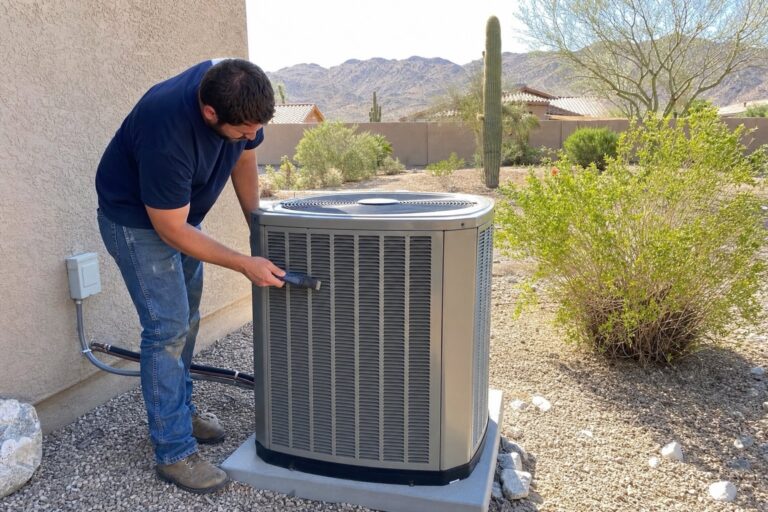
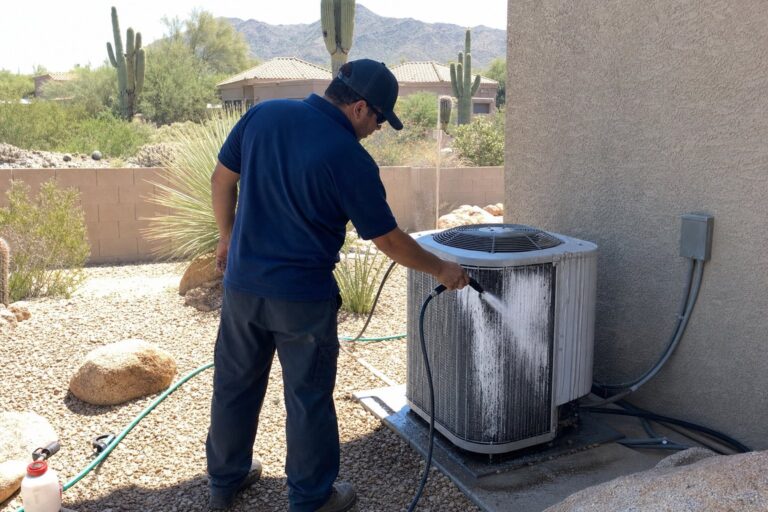
monthly summer filter changes, keeping vegetation and debris two feet clear of the condenser, rinsing visible dust off the condenser fins with gentle hose pressure after dust storms (power off first), and keeping supply registers open and unblocked.
Ours
anything involving refrigerant (EPA-regulated), electrical measurement and components, coil chemical cleaning, condensate treatment, and the instrumented checks that catch failures early. The line is bright: if it needs a gauge, a meter, or a license, it’s ours.
The Phoenix maintenance year, month by month
The cooling tune-up. The sweet spot — parts in stock, schedules open, findings fixable at leisure. This is the appointment that decides your summer.
Last call before the heat. Filter in, condenser clear, thermostat programmed. If the spring visit surfaced a “watch this” item, this is the month to stop watching and fix it.
Your monthly filter changes, condenser rinses after every dust storm (power off, gentle hose), and ears open — new noises in July are the system asking for help early. Post-haboob and post-lightning checks catch storm damage before it compounds.
The heating check — strips, defrost, and reversing valve on heat pumps; burners, flame sensor, and heat-exchanger inspection on gas furnaces. Swamp cooler homes: winterization now prevents spring corrosion.
The system coasts; you enjoy the Valley’s payoff season. Good month to review the year’s condition report and budget any coming replacement on your terms.
Plan members never have to remember any of this — the visits schedule themselves, which is frankly the point.
Maintenance questions, answered straight
Is a tune-up really necessary every year?
In this climate, yes — and spring, before the heat arrives. Phoenix runtime ages wear components on a fast clock; annual measurement is how you catch the trend before the failure. Skipping year one usually costs nothing. It’s year three that gets expensive.
What does your tune-up cost?
We quote the exact price when you book — no coupon games, no bait visit. Plan membership prices the two seasonal visits together with the priority-dispatch and repair-discount benefits included, and the military discount applies.
How is your plan different from the big companies’ clubs?
The mechanics are similar — seasonal visits, priority service, repair discounts. The difference is intent: our visit is measurement-and-report, not a quota-driven sales appointment, and the plan has no auto-renewal traps. Read any plan’s fine print — including ours — before signing; the good ones survive the reading.
My AC seems fine. What would a tune-up even find?
Typically: a capacitor at 80% and falling, a coil surrendering capacity to dust, a drain line half-clogged before monsoon season, a charge a half-pound low from a pinhole leak. None of them are symptoms yet. All of them are July failures on schedule.
Do you maintain rooftop package units and swamp coolers?
Yes — package units get the same instrumented visit (we handle the roof), and evaporative coolers get spring start-ups (pads, pump, float, bleed-off) and fall winterization. Two-system homes can bundle both.
I just bought a house in the Valley. Should the first tune-up wait until spring?
No — book it now, whatever the month. A new-to-you system needs a baseline: equipment age, refrigerant type, component readings, duct condition. That first report tells you what you actually bought and what the next two years likely cost, which beats discovering it during your first Phoenix July.
Can maintenance really prevent compressor failure?
Not every one — compressors do just die sometimes. But the leading killers of Phoenix compressors are preventable stresses: failing capacitors forcing hard starts, dirty coils driving pressure, low charge from unfixed leaks. Maintenance removes those stresses. That’s most of the battle.
Beat the first heat wave to the punch. Call (520) 556-8929 and book your tune-up — veteran-owned, measurement-driven, and honest about what we find.
Permits and inspections
Most repairs are ordinary service work; bigger scopes can involve city permitting. We perform our work to code, pull the permits our scope requires, and put what we did in writing.
What's covered
Workmanship is covered for two full years, in writing, and repair parts carry a 1-year manufacturer parts warranty — we document installs and repairs so those claims stay simple to make
Why a licensed HVAC contractor matters.
Related specialty services.
AC Maintenance in Phoenix, city by city.
Every city below has its own local page for this service — local FAQs, utility territory, housing stock, and dispatch reality included.
Every major brand, serviced and installed.





Phoenix metro: Most days a tech is already working somewhere in the Valley, so same-day appointments happen when the schedule allows. After-hours emergencies are dispatched when a licensed tech is available — a real person answers and tells you the ETA on the call.
Call (520) 556-8929Request an estimate.
No pressure, no door knockers. We look at the HVAC system, tell you what it needs (and what it doesn’t), and put the number in writing.