
Chandler
AC Maintenance in Chandler, AZ.
- (520) 556-8929
- Serving the entire Phoenix metro — we come to you
- Office: Mon–Fri 8:00 AM – 5:00 PM · 24/7 emergency service
- 2-year workmanship warranty · 1-year parts warranty
- Veteran-owned & operated · residential + commercial
- 23 five-star Google reviews
Chandler was built in waves, and its air conditioners age the same way. The subdivisions that filled in around the Price Corridor through the nineties and early 2000s went up street by street, a couple of building seasons apiece, so the builder-grade systems installed with them are hitting their twelve-to-fifteen-year wall in clusters. When one house on the block gets a new condenser, three neighbors are usually a season or two behind, and every one of those failures lands in the same miserable scheduling window. Maintenance is how you opt out of that lottery. An instrumented spring visit, with capacitor values, amp draws, refrigerant numbers, and airflow all documented and trended against prior years, tells you where your system actually sits on its decline curve, so replacement happens on a calendar you chose rather than during the week the whole street's equipment quits. This is AC maintenance in Chandler, AZ as we practice it: measurement first, evidence shown, decisions yours. It suits the city's temperament. Chandler homeowners work in fabs, data centers, and software shops; they don't want a technician's vibes, they want the readings, and we would rather show numbers than perform concern anyway. Yeti Pros is veteran-owned and operated, holding ROC #363372 and #363423, with flat-rate written quotes and a visit fee that's disclosed at booking and credited toward any repair the inspection turns up. A complete residential visit covers the system checks, cleaning, and maintenance work needed to understand how the AC is holding up. What it tends to find in Chandler specifically is below. Call (520) 556-8929 anytime, a real person answers rather than a phone tree, and military families save 10 percent. If your street was framed in 1999, consider this the friendly warning shot.
ZIPs served: 85224, 85225, 85226, 85248, 85249
What AC Maintenance covers in Chandler.
Pre-Summer Tune-Up, Fully Documented
The full instrumented inspection, performed before the heat arrives and recorded as data: every measurement logged, graded against manufacturer specification, and archived for year-over-year comparison. For Chandler systems deep into builder-grade middle age, the trend line answers the question that matters, how many summers are realistically left, answered with real numbers rather than a salesman's shrug.
Capacitor & Electrical Trend Checks
The capacitor is the canary of Phoenix cooling, and its decline is measurable seasons in advance. We record capacitor values against rating, motor amperage against nameplate, and contactor condition at every visit. When a whole subdivision's equipment shares a birth year, these trend checks are what separate your scheduled Tuesday-morning replacement from your neighbors' emergency-queue July.
Condenser & Evaporator Coil Cleaning
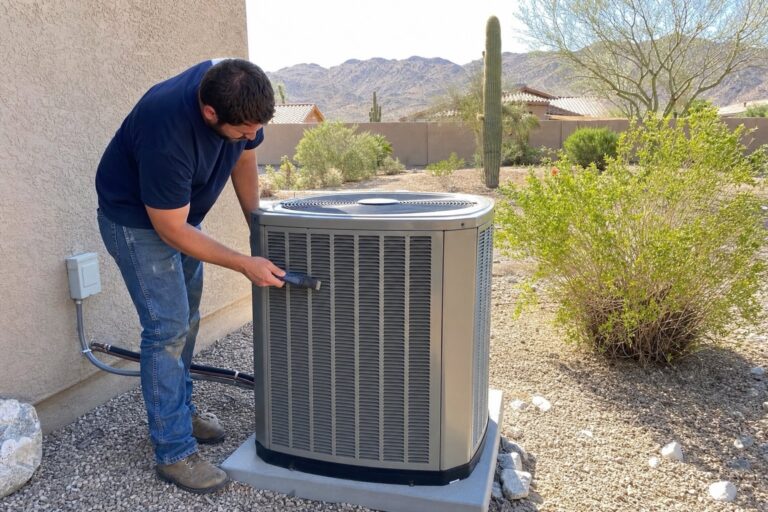
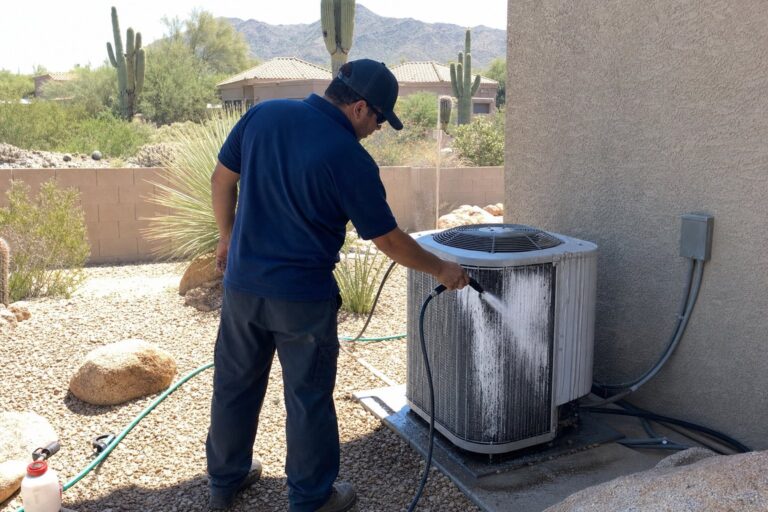
A dust-blanketed condenser coil raises head pressure, stretches runtime, and pushes the compressor toward early retirement, quietly, with the only symptom being an SRP bill creeping upward. We clean the outdoor coil, inspect the indoor one, and document the temperature split both before and after, so the performance recovery is a verified measurement instead of an assurance.
Condensate Flush & Float-Switch Test
In Chandler's two-story homes the air handler usually lives in the attic, putting a clogged condensate line one monsoon week from a stained ceiling below. We flush the drain, confirm the float switch trips before water escapes the pan, and inspect for the algae growth that plugs lines exactly when humidity spikes. Inexpensive insurance against expensive drywall.
Refrigerant Verification by the Numbers
Charge is verified by measurement, through pressures, superheat, and subcooling, by EPA 608-certified technicians, then compared against previous visits. A charge trending downward year over year is a leak announcing itself early, and naming that leak beats topping off refrigerant until the coil finally fails. On equipment this city's age cohort runs, that honesty saves real money.
Priority-Dispatch Maintenance Plan
Both seasonal visits scheduled automatically, priority dispatch when equipment fails during peak weeks, and the complete reading archive maintained visit over visit. The priority matters in Chandler specifically because neighborhood equipment fails in clusters: when your street's 2004 systems drop in the same heat wave, plan members go to the front of the line, not the back.
What we see for AC maintenance in Chandler.
The defining Chandler finding is synchronized aging. A subdivision framed in 1998 got its equipment in 1998, and builder-grade condensers weren't specified to be heirlooms; they were specified to be affordable, and their twelve-to-fifteen-year failure window is now open across whole neighborhoods between Ray Road and Ocotillo. Trend data is the antidote. A capacitor reading a little under rating this spring and much further under next spring is a scheduled replacement; the same part discovered at failure is a queue position in the hottest week of July. We keep those year-over-year numbers for you, and the distance between the two experiences is the entire argument for maintenance.
The second pattern is the two-story complaint. Chandler's housing stock leans hard into two-story floor plans, and the upstairs never cools is the comfort issue we hear most inside them. Maintenance doesn't rebuild ductwork, but it identifies precisely why the upstairs suffers: return-air starvation, duct leakage into a 120-degree attic, a blower losing capacity, or a system that was never balanced after construction. We measure temperature splits and airflow floor by floor and put the cause on paper, so any fix you pursue is aimed at the actual problem instead of the loudest theory.
Around Ocotillo, the equipment gets bigger and the expectations higher, with zoned systems, larger tonnage, and lakeside landscaping shedding into condensers. The failure math stays the same; only the stakes change. Zoned systems also add dampers and control boards to the inspection list, since a stuck damper imitates a dying compressor convincingly enough to fool an invoice out of less careful companies.
And everywhere in Chandler we meet homeowners who want the data. Engineers ask for static pressure readings. Analysts want the capacitor's measured microfarads, not a shrug and the word weak. We hand over every number gladly; a model built on documented evidence has nothing to fear from a customer who reads closely. Frankly, those customers keep this industry honest, and Chandler produces them in bulk. It's our favorite audience.
- 01 Airflow and static pressure
- 02 Electrical: capacitors, contactors, draws
- 03 Refrigerant-circuit behavior
- 04 Drains, safeties, and float switches
- 05 Thermostat, controls, and cycling
- 06 Ducts, returns, and room-by-room comfort
Residential HVAC across the Valley.
Air conditioning, heating, and cooler work at homes across the Phoenix metro.
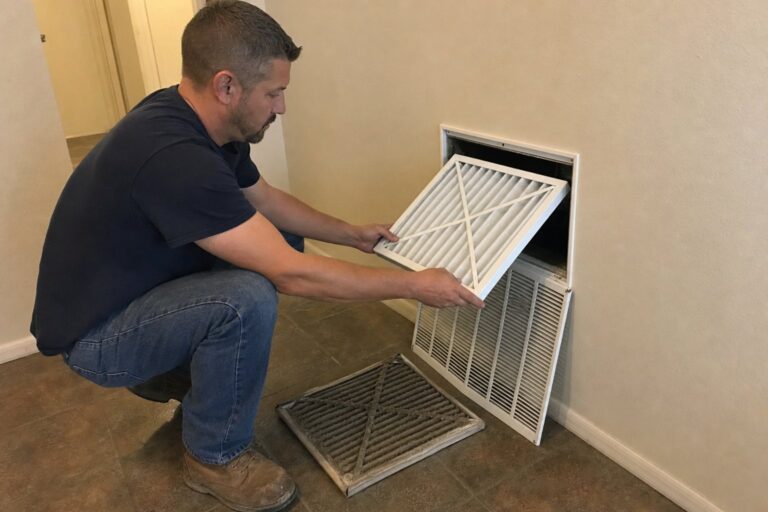
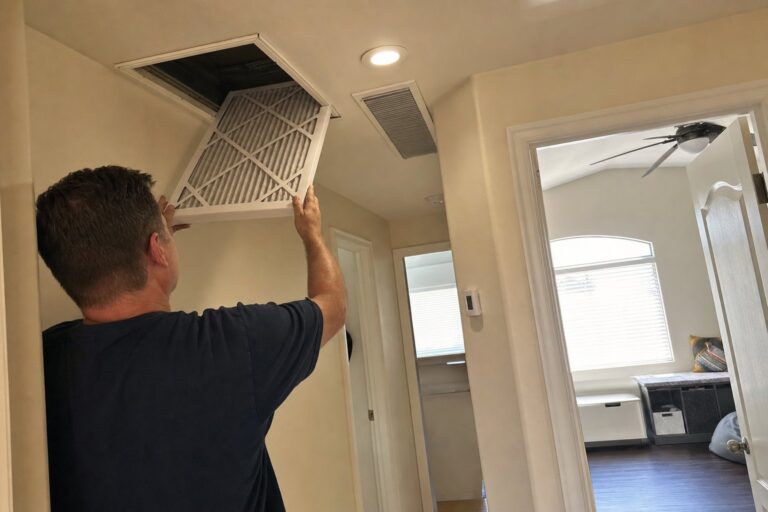
How the job typically runs.
The process is engineered to survive scrutiny, because in Chandler it gets some. When you book, you get the visit fee as a firm number, disclosed up front and credited toward the repair if the inspection finds one. We confirm the appointment window and show up inside it, with a heads-up call en route.
On site, the tune-up runs as a data-collection pass: electrical measurements against component ratings, refrigerant pressures with superheat and subcooling, coil condition, condensate function with a float-switch test, and airflow checks weighted toward upstairs performance in two-story homes. Every reading is shown to you live, beside the specification it's judged against. Ask for the raw numbers and you'll get them without a flinch.
If something is failing, the finding comes as measurement plus spec plus a flat-rate written quote, three things in that order, before any repair conversation starts. The quote is a fixed figure; approve it, decline it, or keep it for later comparison shopping. We're comfortable with all three outcomes because the evidence travels with you.
After approved work, we re-measure to confirm the numbers moved and run the system through a complete cycle. You keep the written report, structured so this year's visit lines up cleanly against next year's, which, on a Chandler-vintage system approaching the far edge of builder-grade life expectancy, is the document that lets you plan a replacement instead of enduring one.
- 01 Booking, with the diagnostic fee disclosed
- 02 In-person diagnosis with real readings
- 03 Written flat-rate quote before work begins
- 04 The work: repair, install, or maintenance
- 05 Startup, documentation, and warranty handoff
Nothing in a maintenance visit requires a City of Chandler permit. Cleaning coils, servicing condensate lines, replacing capacitors or contactors like-for-like, and verifying refrigerant charge are all classified as routine service; the city's permitting process is not involved, and anyone telling you a tune-up needs a permit is confused or selling something. Chandler permits activate at equipment replacement: change out a condenser, air handler, or furnace and a mechanical permit plus inspection is required. Given how many of this city's builder-grade systems are reaching that stage together, it's worth knowing now that when the day comes, we pull the permit and schedule the inspection as part of the job, not as your homework, with the cost shown in the quote.
The standard beneath all of it is Arizona's Minimum Workmanship Standards, the ROC document defining the minimum acceptable quality for licensed-contractor work statewide. Minimum is the operative word: it's the legal floor, and our written warranty on parts and workmanship is deliberately set above it. Refrigerant work carries its own federal layer, EPA 608 certification, which every technician we send to a sealed system holds.
Pricing, financing & the 10% military & first responder discount.
Pricing works the way Chandler homeowners tend to prefer: deterministic. The tune-up fee is a flat figure quoted at booking, not a teaser that inflates once someone is standing in your attic. If the visit uncovers a repair, that fee is credited toward the work, and the repair is quoted flat-rate in writing; the number you approve is the number you're invoiced, independent of how long the job runs. No hourly meter, no discovered surcharges.
We'll also tell you when not to spend. On a fourteen-year-old builder-grade system, some repairs are good money after bad, and our quote will say so rather than harvest the work. When replacement is the rational path, financing options are available so the timing can follow the equipment's condition rather than your cash flow's. Veterans and active-duty military take 10 percent off through the military discount, company policy from a veteran-owned shop, applied to maintenance, repairs, and plans alike. Run the comparison against any club membership you're considering; ours survives spreadsheets, which in this town is a genuine compliment. Plan membership bundles both seasonal visits with repair discounts built in.
- 01 Flat-rate written quote after an in-person look
- 02 Diagnostic fee disclosed at booking, credited to the repair
- 03 Financing available on replacements
- 04 2-year workmanship warranty; 1-year manufacturer parts warranty
- 05 10% military, veteran & first responder discount
Why a licensed HVAC contractor matters.
FAQs: AC Maintenance in Chandler, AZ.
Why is our upstairs always hotter?
A tune-up diagnoses it, the necessary first step. Upstairs heat in Chandler two-stories traces to a short list: leaky ducts running through a scorching attic, starved return air, a blower down on capacity, or a system never balanced after construction, and each fix carries a very different price. We measure airflow and temperature split floor by floor and identify which one you actually have. Sometimes the answer is a cheap adjustment; sometimes it's a zoning conversation. Guessing is the only wrong approach, and it's the common one.
Half the street has replaced their systems. Are we next?
Your street shares a construction year, so shared equipment age is why it feels like an epidemic: builder-grade systems from the same season fail in the same window. One instrumented visit gives your unit a real position: measured capacitor health, compressor amp draw, refrigerant charge, coil condition. Trending those numbers annually shows whether you're two summers from trouble or five. That's a better basis for a replacement budget than watching the neighbors' driveways for equipment deliveries and wondering when the music stops at your house.
Will you show the actual measurements?
Enthusiastically. Every reading is shown live as it's taken and recorded in your written report next to the specification it's judged against: capacitor values versus rating, amperage versus nameplate, superheat and subcooling versus target, temperature split across the coil. Chandler has a high density of people who read data critically, and we consider that a feature of working here. A finding that can't survive an engineer's follow-up questions isn't a finding; it's a sales tactic, exactly the thing this industry deserves to be judged on.
Is AC maintenance in Chandler, AZ worth it at fourteen years?
Arguably more than on a young system, though the goal shifts. Nobody's pretending a tune-up makes a fourteen-year-old builder-grade unit new; the visit's value is control. Documented readings tell you what's declining and how fast, which inexpensive parts genuinely extend the runway, and when the honest play is to stop investing and plan the replacement. That lets you buy equipment in the off-season, at quoted prices, with time to compare bids, instead of at 7 p.m. in a July heat wave with the house at ninety degrees.
Do zoned systems need different maintenance?
They add inspection items rather than changing the basics. Ocotillo's larger homes often run two systems or zone one with motorized dampers, and those dampers plus their control boards join the checklist: a damper stuck half-closed imitates a failing blower or a low charge convincingly, and more than one homeowner has been quoted a repair for a system whose only sin was a zoning fault. We verify dampers, controls, and per-zone airflow, then document each system separately, two reports, one clear picture for a two-system house.
Does SRP time-of-use pricing change the math?
It sharpens it. On time-of-use plans, the expensive hours arrive in late afternoon and evening, exactly when a struggling system runs longest. A fouled coil or low charge doesn't just add runtime; it adds runtime concentrated in premium-priced hours. Maintenance restores capacity so the system finishes its work faster and cycles off during the peak windows. We won't invent a dollar-savings figure for you, but the mechanism is straightforward, and the before-and-after readings we document show the capacity you got back in black and white.
Every major brand, serviced and installed.





Phoenix metro: Most days a tech is already working somewhere in the Valley, so same-day appointments happen when the schedule allows. After-hours emergencies are dispatched when a licensed tech is available — a real person answers and tells you the ETA on the call.
Call (520) 556-8929Request an estimate.
No pressure, no door knockers. We look at the HVAC system, tell you what it needs (and what it doesn’t), and put the number in writing.
Need AC maintenance in Chandler? A real person answers.
Other services we run in Chandler.
AC Maintenance in nearby cities.
Looking for something else nearby? All HVAC services in Chandler