
Chandler
Heating Repair in Chandler, AZ.
- (520) 556-8929
- Serving the entire Phoenix metro — we come to you
- Office: Mon–Fri 8:00 AM – 5:00 PM · 24/7 emergency service
- 2-year workmanship warranty · 1-year parts warranty
- Veteran-owned & operated · residential + commercial
- 23 five-star Google reviews
Chandler built itself in a hurry — the fabs arrived, the subdivisions followed, and whole square miles of the city went up within a few years of each other in the 1990s and early 2000s. The catch shows up now: equipment installed together ages out together, so when builder-grade heat pumps start dying at twelve to fifteen years, they don't fail one house at a time, they fail by the block. That synchronized aging is the single biggest force shaping the heating repair Chandler AZ homeowners are booking this winter. Add the city's two-story-heavy floor plans — where upstairs bedrooms run cold while the thermostat downstairs reads content — and the pattern of winter calls stays remarkably consistent from Ocotillo's lakeside streets to the neighborhoods along the Price corridor. What's less typical about Chandler is the customer. This is the metro's engineering town, and we hear it on every call: people want the static pressure number, the temperature split, the amp draw — not adjectives. Good. Yeti Pros diagnoses with instruments and shows you the screen; conclusions come after readings, never before. We are veteran-owned and operated, we hold Arizona ROC licenses #363372 and #363423, our refrigerant work is EPA 608-certified, and every repair is priced flat-rate in writing before it begins. SRP time-of-use math shapes winter bills here, and we diagnose with that in mind. Dial (520) 556-8929 any hour and a person — not a phone tree — picks up, states the service-call fee, and books the truck. Chandler heating repair starts with what fails here, why it fails, and how we prove the cause.
ZIPs served: 85224, 85225, 85226, 85248, 85249
What Heating Repair covers in Chandler.
Heat-Pump Heating Diagnostics
An instrumented top-to-bottom evaluation in heating mode: supply-and-return split, refrigerant pressures, strip amp draw, defrost behavior, control sequencing — every finding shown on the gauge or meter, not asserted. On Chandler's twelve-to-fifteen-year builder-grade cohort we also flag what is aging but not yet broken, so the next failure isn't a surprise. Numbers first, recommendations second, always.
Auxiliary and Strip-Heat Repair
If your SRP usage graph shows morning spikes that dwarf the rest of the day, rogue strip heat is the leading suspect. We measure each element's draw, repair failed sequencers and relays, replace dead banks, and confirm auxiliary heat engages only when outdoor conditions justify it. Proof lands in the next usage graph — flat where the spike lived.
Reversing Valve and Defrost Repair
A stuck reversing valve turns January heating into refrigeration; failed defrost controls let frost choke the outdoor coil until capacity collapses. Both arrive on schedule in Chandler's 2010-era replacement equipment. We confirm with pressure readings and mode testing, replace the valve or control at one written price, and cycle the system through both modes before signing off.
Gas Furnace Repair
Less common in Chandler than heat pumps, but present in the city's older quarters and in scattered rooftop gas-packs. Ignition faults, flame-sensor failures, sticking gas valves, pressure switches, and boards all get diagnosed component by component, and every gas visit includes exchanger inspection with CO measurement — a non-negotiable step wherever combustion is involved, never an upsell add-on.
Thermostat and Control Faults
Chandler runs more smart thermostats per capita than anywhere we service, and a meaningful share of no-heat calls trace to configuration rather than equipment: missing common wires, wrong system profiles, heat-pump logic toggled to furnace settings. We diagnose the whole control chain, fix the actual fault, and leave staging and schedules configured the way the hardware intends.
Carbon-Monoxide and Safety Checks
For gas-heated Chandler homes: combustion analysis, exchanger inspection, venting check, gas-connection leak test, and CO readings taken at the registers where you would actually breathe it. Results arrive as numbers with the acceptable ranges printed alongside — the format this city prefers — and anything out of spec gets shown to you directly, the reading and the reason included.
What we see for heating repair in Chandler.
The defining pattern is cohort failure. A subdivision framed in 1998 got its equipment replaced around 2010 to 2012, mostly with builder-grade heat pumps carrying thin margins on components — and that whole generation is crossing the twelve-to-fifteen-year line at once. We will repair a failed defrost board on one street and get called two doors down for the identical board a month later. Nothing mysterious about it: same equipment, same duty cycles, same clock. The cohort logic runs deep: the failed part is often predictable from the subdivision's name, and we stock the truck accordingly.
Two-story complaints run second. Most Chandler two-stories heat both floors from a single system, and winter inverts the summer gripe: upstairs bedrooms go cold because undersized returns and long duct runs starve the second floor while the downstairs thermostat sits satisfied. Sometimes the answer is a repair, sometimes a balancing correction, occasionally zoning — we measure airflow room by room before recommending any of them.
Ocotillo adds a premium layer: larger lakeside homes, some genuinely zoned, with owners who expect quiet variable-speed operation and notice any deviation from it. Zone-board and damper faults there masquerade as equipment failures, and separating the two is exactly the kind of instrumented work we enjoy.
Then there's the pattern Chandler homeowners increasingly catch themselves: auxiliary strip heat running rogue. More than one customer has arrived at the truth through their SRP hourly usage graph — consumption tripling at 6 a.m. — before ever picking up the phone. Strips locked in keep the house comfortable while multiplying the bill; a stuck sequencer or thermostat miswire is usually to blame, and the graph flattens within days of the fix. It is the most Chandler failure imaginable: invisible to comfort, obvious in data.
And the perennial: heat-pump supply air measured in the low 90s feels cool against skin at 93 degrees, so blowing-cold calls often close with a thermometer reading and no repair at all. We would rather prove that than invoice it.
- 01 Airflow and static pressure
- 02 Electrical: capacitors, contactors, draws
- 03 Refrigerant-circuit behavior
- 04 Drains, safeties, and float switches
- 05 Thermostat, controls, and cycling
- 06 Ducts, returns, and room-by-room comfort
Residential HVAC across the Valley.
Air conditioning, heating, and cooler work at homes across the Phoenix metro.
How the job typically runs.
The process is engineered for people who like process. When you call, a human quotes the diagnostic fee on the spot — it is credited against any repair you approve, so the visit is never sunk cost. If you have an SRP usage graph showing a morning spike or a thermostat screenshot, send it when you book — good data shortens diagnosis.
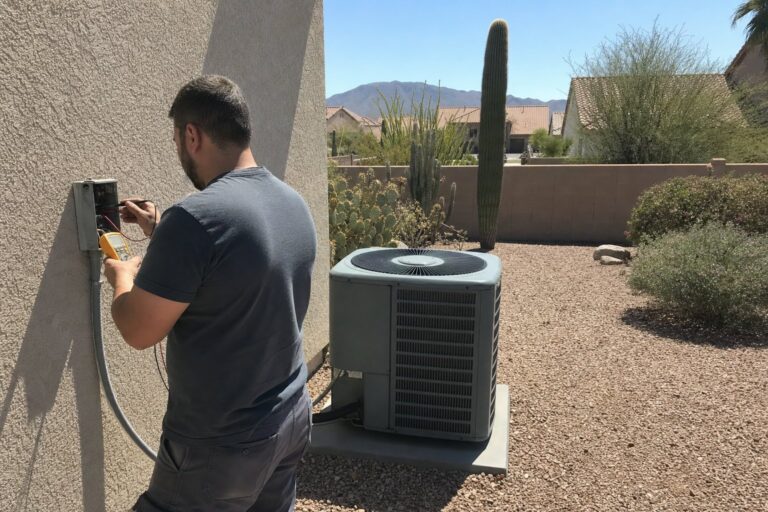
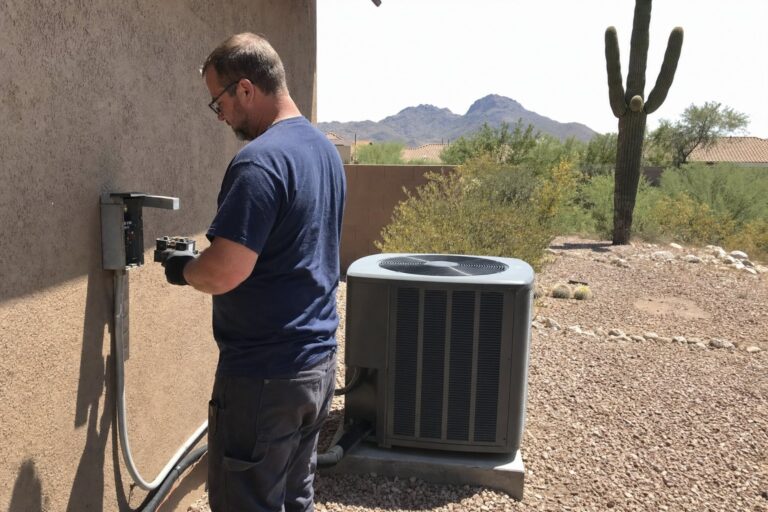
On site the technician works instrument-first: temperature split at the registers, amp draw on strips and motors, refrigerant pressures in heating mode, static pressure where airflow is suspect. Every claim arrives with a number attached, and you are welcome over our shoulder — Chandler customers usually accept. Two-story balancing questions get room-by-room measurements documented the same way.
The quote is flat-rate, written, and delivered before any repair begins: what failed, what we will do, what it costs. The figure holds regardless of how the job unfolds, and declining it means you owe only the disclosed fee — no hostage math.
Verification closes the loop: heating cycles run to completion, supply temperatures re-measured against the pre-repair baseline, strip staging confirmed, and before-and-after readings recorded on the invoice. Most work finishes in one visit; when a part must be ordered, the timeline is stated before we leave the driveway. If you found the problem through your energy dashboard, watch it the following week — the fix should be visible in the data.
- 01 Booking, with the diagnostic fee disclosed
- 02 In-person diagnosis with real readings
- 03 Written flat-rate quote before work begins
- 04 The work: repair, install, or maintenance
- 05 Startup, documentation, and warranty handoff
Repairs stay permit-free in Chandler: boards, sensors, sequencers, blower motors, thermostats, strip elements, and reversing valves are standard service requiring no city involvement. The City of Chandler wants a mechanical permit when the equipment itself changes — a full furnace or heat pump replacement, new gas lines, or added electrical circuits — and if a repair escalates into a changeout, we manage the permit and inspection scheduling ourselves; you see it itemized, never buried. Association approval is not a factor for repairs, though some Ocotillo neighborhoods have rules about equipment visible from the water — relevant only when replacement day comes.
The standard governing every job, permitted or not, is the Arizona Registrar of Contractors' Minimum Workmanship Standards — the state's written floor for acceptable work, and worth knowing exists because it protects you from any contractor, us included. Our own written warranty commits to more than that floor on both parts and labor, since matching a legal minimum is a strange thing to advertise. Verify ROC #363372 and ROC #363423 on the Registrar's lookup — an instinct we endorse.
Pricing, financing & the 10% military & first responder discount.
Flat-rate pricing is the honest kind because it moves the risk onto us: the written number you approve is the number you pay, even when a seized bolt turns a one-hour job into three. Every task is priced from one standard book — a defrost board costs the same in Ocotillo as off Arizona Avenue — and the diagnostic fee disclosed at booking folds into the total the moment you approve a repair — no exceptions, no asterisks.
Cohort aging makes repair-versus-replace the recurring Chandler question, and we answer it with data rather than nudges: the repair quote, a replacement estimate, the equipment's age, and what is statistically likely to fail next. Some twelve-year-old systems deserve the repair; some genuinely don't. Financing is available when replacement wins the math, which softens a December decision considerably. Active-duty military and veterans receive 10 percent off any repair, a standing commitment from a veteran-owned shop. What you will never see from us: trip-fee games, undisclosed after-hours multipliers, or a quote that grows after you approve it.
- 01 Flat-rate written quote after an in-person look
- 02 Diagnostic fee disclosed at booking, credited to the repair
- 03 Financing available on replacements
- 04 2-year workmanship warranty; 1-year manufacturer parts warranty
- 05 10% military, veteran & first responder discount
Why a licensed HVAC contractor matters.
FAQs: Heating Repair in Chandler, AZ.
Why is upstairs freezing while the downstairs thermostat reads fine?
Because the thermostat only knows one truth, and it lives downstairs. Most Chandler two-stories push both floors off one system, and long duct runs plus undersized upstairs returns mean the second floor loses the airflow contest — the stat satisfies before the bedrooms warm. We measure delivery room by room, then match the fix to the finding: duct balancing sometimes, a weak-blower repair other times, occasionally a zoning conversation. What we refuse to do is guess, because three different causes produce this exact same complaint.
Should we worry that the whole street's equipment is 2011-vintage?
Not worry — plan. Equipment installed together fails together, and 2010-to-2012 builder-grade units are crossing the age where defrost boards, reversing valves, and contactors begin to go. When two neighbors' systems fail, yours is running the same clock, so a winter checkup that tests strips, defrost, and valve operation is rational rather than paranoid. If components are measurably degrading, you see the readings and decide with real information. Plenty of that cohort runs fine to year twenty — the measurements tell you which kind you own.
Can I watch the diagnosis and see the actual readings?
Please do — Chandler is the one city where customers ask for static pressure numbers before we have offered them. Our technicians narrate the work: here is the temperature split, here is the amp draw on that strip bank, the pressure signature proving the valve stuck. The numbers go onto the invoice, not just into conversation, so you can compare them against future service or your own research. An informed customer usually approves repairs faster and has less reason to dispute them; instrumented transparency helps both sides.
My SRP app shows a big morning usage spike. Heating?
Almost certainly — and you have done the first diagnostic step yourself. A morning spike towering over the rest of the day is the signature of auxiliary strips carrying recovery from an overnight setback: legitimate on cold mornings, suspicious when it happens daily in mild weather. Deep setbacks also force aux heat every morning by design, and shrinking the setback often cures that free. A latched sequencer or bad staging needs repair instead. Send the graph when you book and we start at the strip circuit.
Is 92-degree supply air from a heat pump normal?
Completely — and points for measuring it. Heat pumps deliver supply air roughly 15 to 30 degrees above return temperature, landing in the high-80s-to-100 range most days: plenty to heat the house, underwhelming against skin. A gas furnace's hotter blast is the comparison your body remembers. What matters is the split between return and supply and whether the house holds setpoint. If your split collapses below that range or the home keeps losing ground, something real is wrong — that is the reading worth a phone call.
What does a heating repair visit in Chandler cost?
We won't quote a number sight-unseen — anyone who does is guessing at your expense — but the structure is fixed. The kind of heating repair Chandler AZ homes need follows one sequence: the service-call fee is named when you book, the diagnosis produces a written flat-rate quote for the specific failure, and that fee folds into the repair price on approval. The quote holds no matter how the job unfolds. Decline and you have paid only the disclosed fee for a documented, instrumented diagnosis.
Every major brand, serviced and installed.





Phoenix metro: Most days a tech is already working somewhere in the Valley, so same-day appointments happen when the schedule allows. After-hours emergencies are dispatched when a licensed tech is available — a real person answers and tells you the ETA on the call.
Call (520) 556-8929Request an estimate.
No pressure, no door knockers. We look at the HVAC system, tell you what it needs (and what it doesn’t), and put the number in writing.
Need heating repair in Chandler? A real person answers.
Other services we run in Chandler.
Heating Repair in nearby cities.
Looking for something else nearby? All HVAC services in Chandler