
Tempe
Furnace Repair in Tempe, AZ.
- (520) 556-8929
- Serving the entire Phoenix metro — we come to you
- Office: Mon–Fri 8:00 AM – 5:00 PM · 24/7 emergency service
- 2-year workmanship warranty · 1-year parts warranty
- Veteran-owned & operated · residential + commercial
- 23 five-star Google reviews
Tempe ran out of dirt decades ago. Landlocked between Phoenix, Scottsdale, Mesa, and Chandler, it builds almost nothing new — which means its heating problems live in the housing it already has: mid-century neighborhoods like Maple-Ash and Holdeman with flat roofs and rooftop package units, post-war blocks with gas furnaces tucked in hall closets, and one of the metro's heaviest concentrations of rental housing orbiting ASU. That mix is why Tempe furnace repair calls come through a landlord almost as often as a homeowner. Yeti Pros works both sides of that arrangement daily. We are veteran-owned and operated, licensed under ROC #363372 and ROC #363423, and when you dial (520) 556-8929 you reach a person, whatever the hour — a tenant reporting no heat at 11 p.m. gets answered the same as an owner calling at 11 a.m. Gas heat is genuinely common in Tempe because the stock is genuinely old: homes built from the fifties through the seventies were plumbed for gas as a matter of course, and many still burn it every winter, either through a closet furnace or the heating section of a package unit on a flat roof. Furnace repair here means small lots, older ducts, landlord approval chains, and the August lease-turnover rhythm that can hide heating failures until the first cold night in December. Every zip from 85281 to 85284 is inside our normal running routes, and SRP territory cold snaps into the thirties are exactly when we prove useful. Owners get documentation built for remote approvals; tenants get heat back without waiting on a mystery.
ZIPs served: 85281, 85282, 85283, 85284
What Furnace Repair covers in Tempe.
Hot-Surface Igniter Swap
On Tempe's flat-roof package units, the igniter bakes in direct sun all summer, then gets asked to glow in December — a recipe for cracked ceramic. It is the most frequent failure we pull off Maple-Ash rooftops. We confirm failure with a resistance test, install the correct element, and run the ignition sequence to verify.
Flame Sensor Cleaning & Renewal
Rooftop equipment lives in dust, and rental furnaces run on filters nobody changes — both foul flame sensors, producing the start-stop-lockout cycle tenants describe as the heat 'trying.' We clean or replace the sensor, verify the flame signal with a meter, and document readings before and after, so an owner approving remotely sees the repair proven.
Gas Valve & Pressure Switch Repairs
Tempe's fifties-through-seventies gas stock means older valves and safety switches are everyday finds. A pressure switch that cannot prove draft, cracked sensing tubing, or a valve gone lazy will strand a furnace mid-sequence. This work stays with licensed technicians: draft verified by measurement, valve response tested, every disturbed fuel connection leak-checked before we close up.
Control Board Evaluation
A package unit's board endures rooftop summers ground-level furnaces never experience, and erratic winter behavior is the bill coming due. We read the stored fault history, test what the board commands against what actually happens, and separate true board death from a board accurately reporting some other failure — the distinction that keeps repair invoices honest.
Blower Motor & Duct Airflow Work
Holdeman and Maple-Ash ducts were sized for smaller equipment and gentler loads, and sixty years of joints loosening has not helped. We repair blower motors, bearings, and loaded wheels, then measure static pressure to show where airflow dies. In older Tempe homes the honest fix is sometimes sealing and returns, and we say so when it is.
Heat Exchanger & CO Documentation
Older gas equipment plus rental occupancy makes combustion safety documentation non-optional. Every gas call includes a heat-exchanger inspection and an in-home carbon monoxide reading, recorded on paperwork landlords can keep on file. A compromised exchanger gets photographed and explained with options; a healthy one gets certified in writing — worth something at every lease signing thereafter.
What we see for furnace repair in Tempe.
Maple-Ash and Holdeman define one whole category of Tempe work: flat-roofed mid-century homes heated by rooftop package units with gas heating sections. Those units take unfiltered Arizona sun twelve months a year, so igniters, boards, and wiring insulation age faster than their ground-level cousins. The ducts below them are often original — undersized trunks snaking through shallow ceiling chases, leaking conditioned air into spaces nobody can reach without effort. When a Holdeman house heats slowly and unevenly, the roof unit and the ductwork share the blame more often than either carries it alone.
The rental economy creates the second category. A huge share of Tempe housing is tenant-occupied, and rental heating systems accumulate deferred maintenance in a way owner-occupied systems do not: nobody changes the filter, small symptoms go unreported, and the furnace's condition is discovered by whoever is leasing it on the first cold night. The repair itself is standard; the coordination is not. Tenants report, owners or property managers approve, and the technician in the middle needs to document everything well enough for a decision-maker who is not standing in the room.
August turnover sets the calendar trap. Tempe leases roll over in late summer, when it is 110 degrees and nobody on earth is testing the heat. Move-in inspections check the air conditioning and skip the furnace entirely, so ignition failures, fouled sensors, and dead boards sit undiscovered until December — then arrive all at once, across dozens of properties, the week of the first real cold front.
Small lots and tight access round out the picture. Alley-loaded properties, converted casitas behind main houses, mechanical closets that share space with the water heater — Tempe geometry demands technicians who work clean in cramped spaces and roofers' habits on older parapet roofs. And because so much of this stock burns gas and shelters students or young renters, our carbon monoxide checks carry real weight here: every gas call gets a reading, documented, no matter who is paying the invoice.
- 01 Airflow and static pressure
- 02 Electrical: capacitors, contactors, draws
- 03 Refrigerant-circuit behavior
- 04 Drains, safeties, and float switches
- 05 Thermostat, controls, and cycling
- 06 Ducts, returns, and room-by-room comfort
Residential HVAC across the Valley.
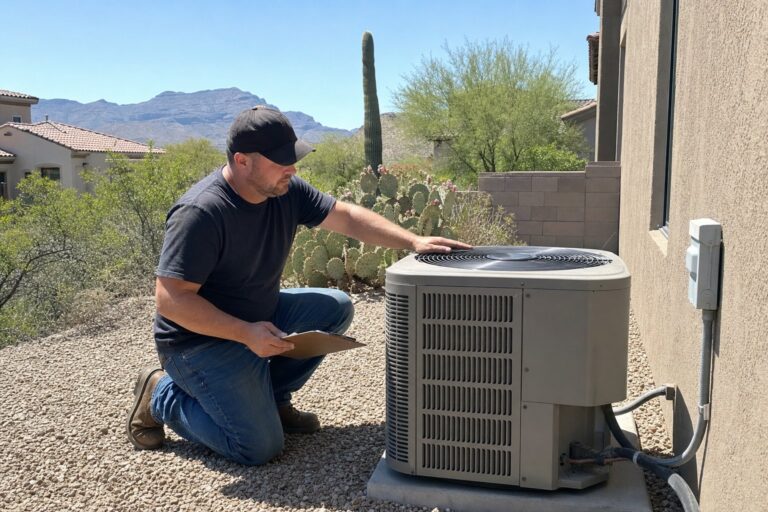
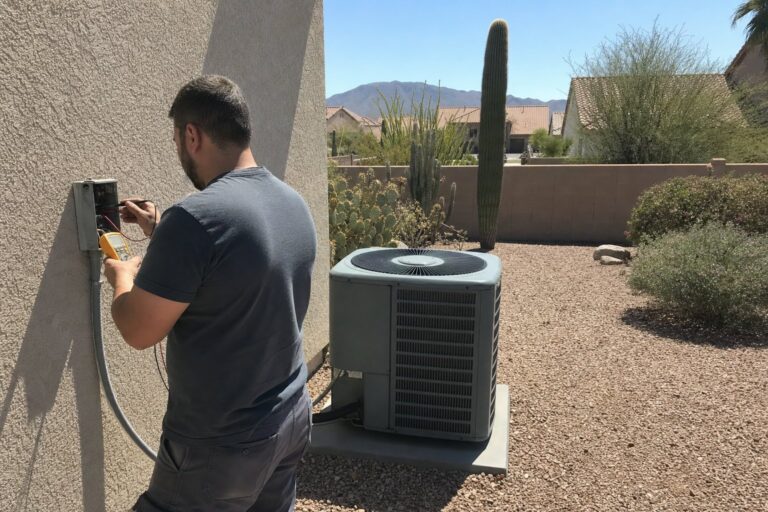
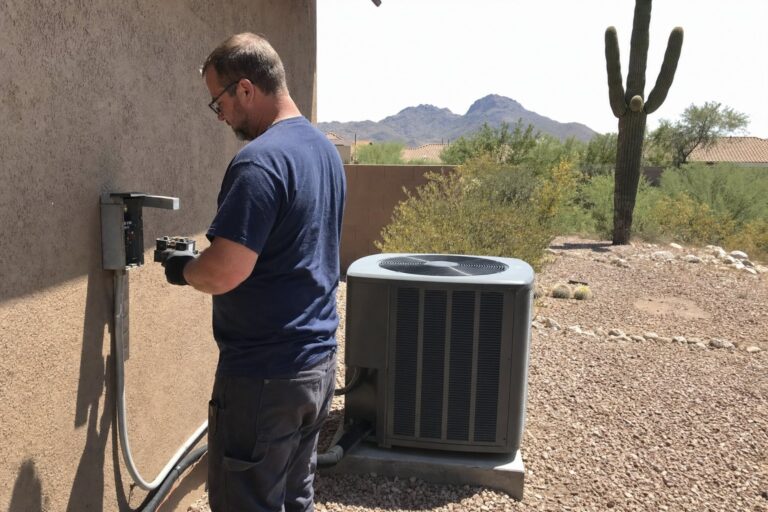
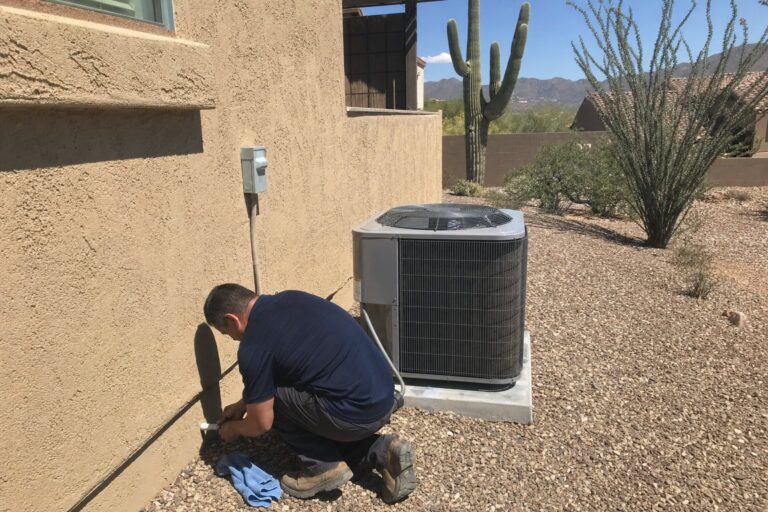
Air conditioning, heating, and cooler work at homes across the Phoenix metro.
How the job typically runs.
Call (520) 556-8929 and the service-call fee is quoted before the appointment exists; if the repair goes ahead, that fee becomes a credit against it. Simple, and disclosed in that order on purpose.
For rentals, we run a clean approval chain. The tenant or manager gives us access — lockbox, key release, or a scheduled meet — and the technician diagnoses with documentation built for remote decision-making: photos of the failed component, the meter readings, the written flat-rate quote. That package goes to the owner or property manager, approval comes back by phone or text, and work proceeds only after it does. Owners never authorize blind, and tenants never get stuck negotiating a repair they cannot approve.
Owner-occupied visits skip the middle step but keep the substance: full ignition-sequence testing, the failed part shown in hand, evidence before price, price in writing before work.
Rooftop calls in Maple-Ash and Holdeman include safe parapet access and combustion checks on the package unit's heating section — treated with the same rigor as a closet furnace, because the physics does not care about the altitude.
Every gas visit closes with verification: complete heating cycles run, temperature rise measured, carbon monoxide reading taken and recorded. Landlords get the documentation for their files; it tends to be exactly what they want on record when a tenant asks whether the heat is actually fixed. Everything documented, every time.
- 01 Booking, with the diagnostic fee disclosed
- 02 In-person diagnosis with real readings
- 03 Written flat-rate quote before work begins
- 04 The work: repair, install, or maintenance
- 05 Startup, documentation, and warranty handoff
Repair work at the component level — igniters, flame sensors, pressure switches, gas valves, control boards, blower motors — requires no permit from the City of Tempe, whether the equipment is a closet furnace or a rooftop package unit. Diagnosis and repair can happen in a single visit with no municipal paperwork.
Replacement is different. Swapping out a furnace or an entire package unit, running new gas piping, or modifying venting all require City of Tempe mechanical permits and inspection. Landlords should care more than most: unpermitted changeouts surface during sales and insurance claims, and the liability lands on the owner. When a repair call becomes a replacement conversation, permit handling is included in our replacement quote as a matter of course.
The statewide baseline beneath all of it is the Arizona Registrar of Contractors' Minimum Workmanship Standards — the minimum the law will accept from a licensed contractor. Our written warranty is set above that baseline deliberately, and it travels with the property, which matters in a city where the person paying and the person living with it are frequently not the same household.
Pricing, financing & the 10% military & first responder discount.
Flat-rate pricing earns its keep in Tempe specifically because of how many repairs are approved from a distance. An owner in another state cannot stand next to the technician, so the quote has to do the standing: one written number, tied to a documented diagnosis with photos, that will not grow after approval. That is what we send — and why property managers keep our number.
The service-call fee is stated at booking and credited toward the repair on approval — for landlords, that means a no-heat complaint can be diagnosed and resolved in one authorization without fee-stacking. Declining a quote costs only the disclosed fee, never a renegotiation.
Financing is available when aging equipment turns a repair into a replacement decision, which Tempe's mid-century stock produces regularly.
And in a city with this many people connected to military service, our ownership matters: Yeti Pros is veteran-owned, and the 10 percent military, veteran & first responder discount is permanent, applies to every service, and goes into the written quote when you mention it at booking — active duty, veterans, no expiration, no fine print.
- 01 Flat-rate written quote after an in-person look
- 02 Diagnostic fee disclosed at booking, credited to the repair
- 03 Financing available on replacements
- 04 2-year workmanship warranty; 1-year manufacturer parts warranty
- 05 10% military, veteran & first responder discount
Why a licensed HVAC contractor matters.
FAQs: Furnace Repair in Tempe, AZ.
How does furnace repair Tempe AZ work for landlords who aren't on site?
Built for exactly that. Your tenant or manager provides access, we diagnose, and you receive a documentation package: photos of the failed component, the meter readings behind the diagnosis, and a flat-rate quote in writing. You approve by phone or text before work starts, the fee you heard at booking credits toward the repair, and completed-work paperwork lands in your records — including the carbon monoxide reading from every gas call. One authorization, no surprises, and your tenant gets heat without you boarding a plane.
I'm a renter with no heat. Can I call you directly?
Call either way — a real person answers around the clock and can tell you what is likely happening. But authorization to spend money on the repair comes from whoever owns the equipment, so the fastest path is looping in your landlord or manager immediately; we will speak with them directly and send the diagnosis to their phone. If you are cold tonight, report it in writing to your landlord as well. Arizona rental law treats heat as an essential service, which tends to focus attention.
Do you service rooftop package units on Maple-Ash flat roofs?
Constantly — those mid-century flat roofs are core Tempe territory for us. Package units combine cooling and gas heating in one rooftop cabinet, and their heating sections fail the same ways closet furnaces do, accelerated by constant sun. We handle parapet access safely, service burners, igniters, sensors, and boards up top, and run the same heat-exchanger and carbon monoxide checks as at ground level. Original ductwork under those roofs often shares blame for weak heat, so we measure airflow rather than assuming the unit did it.
Why do heating problems appear in December instead of at move-in?
Because nobody tests heat in a Tempe August. Move-ins peak at lease turnover in triple-digit heat, inspections focus on the air conditioning, and the furnace or heating section sits unproven until the first real cold front. Whatever failed the previous winter — or degraded quietly over summer — is simply waiting. That is why December cold snaps unleash a wave of brand-new problems across Tempe rentals at once. If you manage property here, a quick fall heating test costs little and prevents exactly this call.
My Holdeman house heats slowly and unevenly. Furnace or ducts?
In Holdeman it could genuinely be either — often both. The mid-century duct runs under those low roofs were undersized, and decades of loosening joints leak warm air into ceiling cavities before it reaches the far rooms. Meanwhile the equipment itself may be down a blower bearing or short-cycling on its high limit. We measure static pressure and temperature rise to apportion blame with numbers instead of hunches, then quote the repair that addresses what the measurements show. Paying to fix the wrong half solves nothing.
Is a fifty-year-old gas furnace safe to keep running?
Only with its safety systems verified — age alone is not a verdict, but it raises the stakes. On every gas call we inspect the heat exchanger, confirm the safety chain still does its job, and measure carbon monoxide in the living space, results documented. A sound old furnace can keep earning winters; a compromised exchanger means we show you photos and have the shutdown conversation honestly. Either way, CO detectors belong in every gas-heated Tempe home, especially rentals where occupants never saw the equipment installed.
Every major brand, serviced and installed.


Phoenix metro: Most days a tech is already working somewhere in the Valley, so same-day appointments happen when the schedule allows. After-hours emergencies are dispatched when a licensed tech is available — a real person answers and tells you the ETA on the call.
Call (520) 556-8929Request an estimate.
No pressure, no door knockers. We look at the HVAC system, tell you what it needs (and what it doesn’t), and put the number in writing.
Need furnace repair in Tempe? A real person answers.
Other services we run in Tempe.
Furnace Repair in nearby cities.
Looking for something else nearby? All HVAC services in Tempe