
Peoria
Heating Repair in Peoria, AZ.
- (520) 556-8929
- Serving the entire Phoenix metro — we come to you
- Office: Mon–Fri 8:00 AM – 5:00 PM · 24/7 emergency service
- 2-year workmanship warranty · 1-year parts warranty
- Veteran-owned & operated · residential + commercial
- 23 five-star Google reviews
Peoria is two heating markets wearing one city-limits sign. Down along the Grand Avenue corridor in 85345, the housing is older West Valley stock: mid-century and seventies-era homes where gas furnaces still handle winter and the ductwork has stories to tell. Climb north through 85381 into 85382 and 85383 and you enter master-plan country: Vistancia, Trilogy, and their neighbors, nearly all-electric, nearly all heat pumps, with Westbrook Village's 55-plus community holding the middle ground and APS serving practically every meter. One more thing sets this city apart, and it arrives sideways: Peoria sits first in line on the metro's northwest storm track, so when a dust wall rolls off the open desert, Peoria's outdoor units eat it before anyone else's, and the bill for that grit often comes due months later, in heating season, as defrost faults and scrambled control boards. Yeti Pros runs winter service across all of it. We are veteran-owned and operated, licensed as ROC #363372 and ROC #363423, EPA 608-certified for refrigerant work, and reachable at (520) 556-8929 with an actual human answering at any hour. Quotes are flat-rate and written; the service-call fee is disclosed when you book and credited toward the repair you approve. If you searched heating repair Peoria AZ because the house refused to warm up this morning, the short version is that we fix heat pumps, gas furnaces, and everything that controls them. What follows is the Peoria-specific picture, because a Trilogy heat pump and a Grand Avenue furnace die in completely different ways, and a company working both ends of this city needs to know each failure by heart.
ZIPs served: 85345, 85381, 85382, 85383
What Heating Repair covers in Peoria.
Heat Pump Heating Diagnostics
North Peoria's master-plan neighborhoods run on heat pumps, and we diagnose them the way the season demands: supply temperatures measured, refrigerant verified by an EPA 608-certified technician, staging confirmed, airflow checked. On dust-exposed units we inspect the outdoor coil and its sensors as part of the workup, since many Peoria winter faults start as summer grit.
Reversing Valve & Defrost Repair
Defrost circuits fail more often in Peoria than in most Valley cities, because haboob dust cakes the sensors that tell a heat pump when to thaw its coil. We clean, test, and replace defrost thermostats and boards, verifying reversing valves electrically before condemning them; an iced-over Vistancia unit usually needs a sensor, not the compressor somebody else quoted.
Auxiliary & Emergency Strip Heat Repair
Backup electric strips decide whether a cold night is comfortable or miserable in an all-electric home. We test elements, sequencers, and relays; revive strips that will not engage on freezing mornings; and shut down strips stuck running that inflate an APS bill invisibly. Westbrook Village homes get particular attention here, since backup heat covers aging primary equipment.
Gas Furnace Repair
The Grand Avenue corridor's older homes still heat with gas, and we service those furnaces across every failure mode: igniters, flame sensors, pressure switches, gas valves, boards, and blowers. Exchanger inspection and a CO reading come standard with the visit, because equipment that has burned gas since the eighties deserves that level of scrutiny every time.
Thermostat & Control Faults
Storm-night power blinks are Peoria's signature thermostat killer — blank displays, blown low-voltage fuses, and boards left confused by the surge. We trace control faults to the actual failed part instead of shotgunning components, replace builder-grade thermostats with correctly configured ones, and make sure heat-pump settings match the equipment, something the original installs frequently got wrong.
Carbon Monoxide & Safety Checks
Any home burning gas for heat gets the full safety workup: combustion analysis, venting verification, exchanger inspection, and CO measured at the registers. In Peoria's older core, where flues and equipment have been modified across generations of remodels, this check regularly finds what previous shortcuts left behind. It rides along, drama-free, on every gas-heat visit.
What we see for heating repair in Peoria.
Peoria's winter call sheet has a fingerprint no other Valley city quite matches, and dust is all over it.
The haboob debt comes due in December. Summer dust walls roll off the northwest desert and hit Peoria before anywhere else in the metro. Grit packs into outdoor coils and cakes onto defrost sensors, and the system seems fine until heating season, when a contaminated sensor misjudges coil temperature and the unit either ices into a block or defrosts constantly without ever delivering real heat. We clean and test defrost circuits on dust-exposed units as a matter of course, because up here that step is the difference between a lasting repair and a callback. It repeats every winter.
Storm-night failure clusters. When a winter front knocks power around, the next morning brings a cluster: blank thermostats, blown low-voltage fuses, control boards scrambled by the blink. Most are quick fixes; the skill is telling a blown fuse from a board that genuinely died, and testing beats guessing every time.
Grand Avenue's gas-furnace core. The older stock in 85345 still heats with gas, in closets that have hosted three generations of equipment. Flame-sensor fouling, igniter failures, and venting trouble lead the list, and each of those visits includes a heat-exchanger inspection and carbon-monoxide reading, because furnaces of that age have earned the scrutiny.
Vistancia and Trilogy hit the first-repair window. The master-plan north is heat-pump country, and homes from the 2000s boom are now producing reversing-valve, defrost-board, and strip-heat work right on schedule. Two-story layouts add balance complaints: an upstairs that roasts while the downstairs shivers is usually a zoning or airflow problem, not a broken machine.
Westbrook Village runs older equipment around the clock. In a 55-plus community, a night without heat is a health matter rather than an inconvenience, so those calls jump to the front of the queue during cold snaps — and we test strip heat carefully there, since backup heat is what keeps a slowly declining heat pump livable through January.
- 01 Airflow and static pressure
- 02 Electrical: capacitors, contactors, draws
- 03 Refrigerant-circuit behavior
- 04 Drains, safeties, and float switches
- 05 Thermostat, controls, and cycling
- 06 Ducts, returns, and room-by-room comfort
Residential HVAC across the Valley.
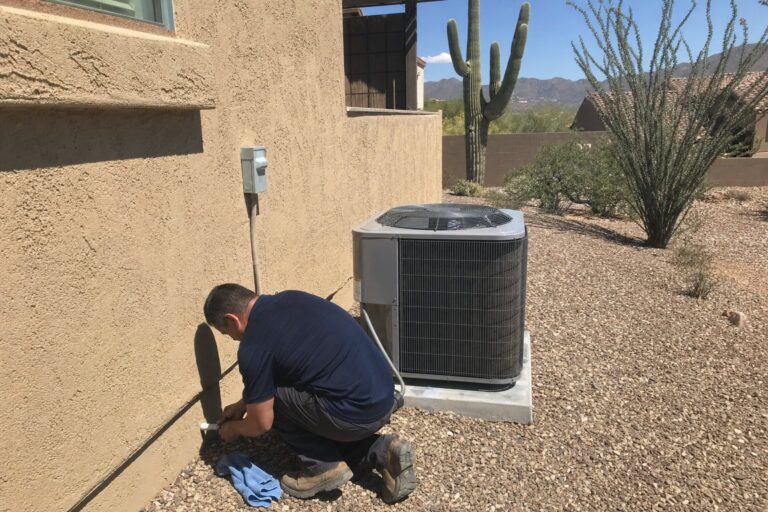
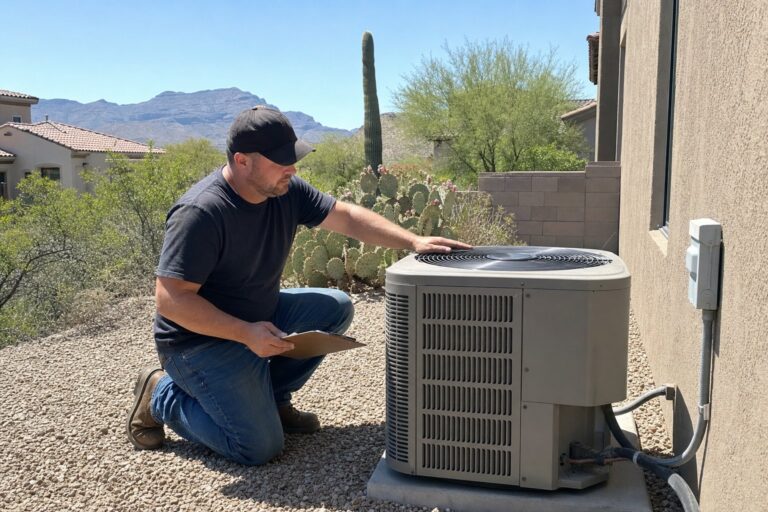
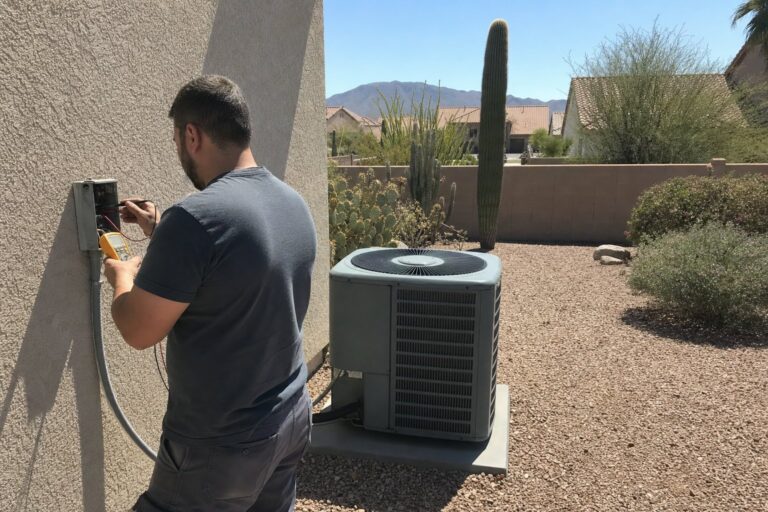
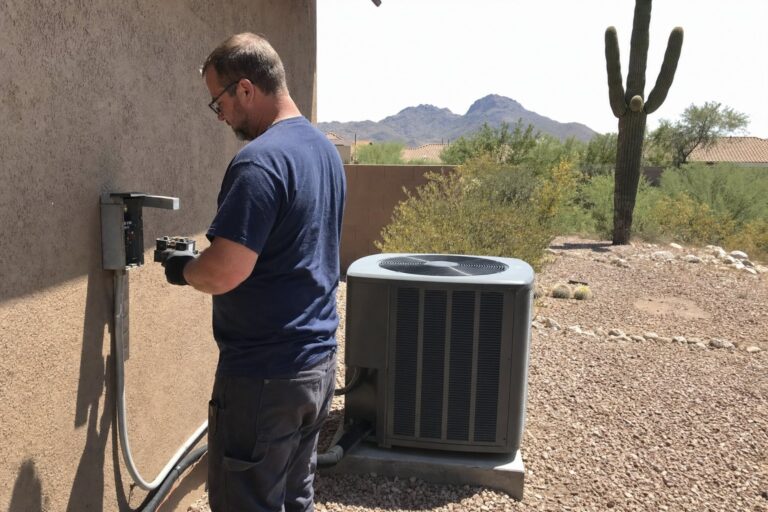
Air conditioning, heating, and cooler work at homes across the Phoenix metro.
How the job typically runs.
The visit starts on the phone with a human who quotes the service-call fee before anything gets scheduled. No dispatch surprises. If you live behind a gate at Vistancia, Trilogy, or Westbrook Village, we collect access details at booking so the technician is not idling at a keypad while your house sits cold.
Diagnosis comes with receipts. You see the dust-packed defrost sensor, the meter reading on the failed board, the amp draw on the strips: physical evidence first, a plain-English explanation second, and only then a price. That price is a written flat rate, and the fee from booking is credited into it the moment you approve.
Peoria adds texture we have learned to plan around. Westbrook Village visits get a call-ahead and an unhurried walkthrough, because we talk with the homeowner, never past them. Rental homes along the Grand Avenue corridor usually need an off-site owner's sign-off, so we send photos and the written quote by email to shorten that approval loop. And on mornings after a storm front, when failures cluster across north Peoria, each caller hears their honest place in the day, not the same fictional window.
The job closes with proof: complete heating cycles run, vent temperatures measured, defrost observed on heat pumps, combustion and CO verified on gas — then the paperwork and the written warranty go in your hand before the truck leaves the curb.
- 01 Booking, with the diagnostic fee disclosed
- 02 In-person diagnosis with real readings
- 03 Written flat-rate quote before work begins
- 04 The work: repair, install, or maintenance
- 05 Startup, documentation, and warranty handoff
For the everyday repair, Peoria asks for no paperwork: swapping a defrost board, sequencer, igniter, blower motor, thermostat, or strip element is component-level work and does not trigger a permit. The City of Peoria's development services desk gets involved when the equipment itself changes: a full furnace or heat-pump changeout, new gas piping, a new dedicated electrical circuit, or flue and venting alterations all need a permit and inspection, and we handle that filing whenever a job crosses the line. One local wrinkle worth naming: HOA architectural rules in the master-plan communities govern where visible equipment can sit, but an HOA approval is not a city permit and never substitutes for one — occasionally we find past work where somebody confused the two. The statewide floor under all of this is the Arizona Registrar of Contractors' Minimum Workmanship Standards, the legal minimum any licensed contractor owes you. Our written warranty runs past that floor on purpose — the state defines the least you should accept, and we would rather be judged against a higher line than the lowest legal one.
Pricing, financing & the 10% military & first responder discount.
Storm weeks test a contractor's pricing character, and ours does not bend: the flat rate we would quote on a calm Tuesday is the same flat rate we quote the morning after a front knocks out twenty systems, because scarcity pricing is not something we do to neighbors. Every quote goes in writing before any work starts, and the service-call fee disclosed at booking folds into the repair cost when you say yes; you never pay it on top. If a diagnosis turns up a borderline machine, you get the repair number and the replacement conversation in the same visit, with zero pressure attached to either path. Financing exists for the repairs that cannot wait, and we raise it up front rather than letting a cold house force a rushed decision. Veterans and military families throughout Peoria — and the West Valley has plenty — receive 10 percent off through the military, veteran & first responder discount, a standing thank-you from a veteran-owned shop, not a promotion with an expiration date attached. Ask when you book; nobody makes you prove anything twice.
- 01 Flat-rate written quote after an in-person look
- 02 Diagnostic fee disclosed at booking, credited to the repair
- 03 Financing available on replacements
- 04 2-year workmanship warranty; 1-year manufacturer parts warranty
- 05 10% military, veteran & first responder discount
Why a licensed HVAC contractor matters.
FAQs: Heating Repair in Peoria, AZ.
Can a summer dust storm cause heating failure months later?
Yes, and it is Peoria's most distinctive repair pattern. Haboob grit packs the outdoor coil and coats the defrost sensor, and cooling season masks the damage. Come December, the contaminated sensor misreads coil temperature: the unit either ices into a solid block or runs defrost constantly and never produces real heat. Neither symptom looks like a dust problem, which is exactly why it gets misdiagnosed. We inspect and clean defrost components on dust-exposed units as part of the diagnostic itself, not as an upsell afterward.
Who handles heating repair in Peoria, AZ after storm fronts?
We do, and we handle it honestly. Storm-night power blinks produce failure clusters — a dozen blank thermostats and locked-out systems before breakfast — and any company promising every caller an identical arrival time is telling some of them a story. We stack the day by triage: homes sitting without heat around seniors or newborns come first, then everyone else in a sequence we state plainly when you call (520) 556-8929. Most storm-cluster faults resolve fast once the technician arrives — fuses, resets, and the occasional board.
Our Westbrook Village unit is original to the house. Worth repairing?
Sometimes, and we will tell you the truth either way. The deciding factors are compressor health, strip and exchanger condition, and what the specific failed part costs against the machine's remaining life. A sound older unit with a failed sequencer is absolutely worth fixing; a unit dropping its second major component in two winters is spending your money in installments. You get both numbers in writing during one visit, and in a 55-plus community we schedule, explain, and walk through everything at whatever pace the homeowner prefers.
Why is my Vistancia upstairs warm while downstairs stays cold?
Usually balance, not breakage. Two-story master-plan homes often run one system for both floors, and heat rises: thermostat location, damper positions, and duct design decide which floor wins. If the system has zoning, a stuck damper or failed zone board creates exactly this complaint; if it does not, adjusting registers and fan strategy narrows the gap. A genuine capacity fault presents differently: the whole house lags together. We measure temperatures floor by floor and tell you which case your home has before anything gets replaced.
My thermostat went blank after a power blink. System dead?
Probably not. A blank display after an outage usually means a blown low-voltage fuse, a tripped safety switch, or a control board protecting itself: inexpensive diagnoses, common across north Peoria after winter fronts. Occasionally a surge does take out the board or transformer, which is a bigger repair, and the only way to know is testing rather than guessing. Resist the urge to cycle breakers hoping it wakes up; if two resets have not restored it, a tenth will not either, and repeated cycling can worsen things.
My furnace smells like burning dust each fall. Normal?
For the first hour, yes — a summer's worth of settled dust cooking off the exchanger is ordinary, especially in Peoria where dust is a fact of life. What is not normal: a burning smell that persists into the next day, anything electrical or plastic in the odor, or a smell paired with short cycling. Those point toward overheating, a failing blower, or wiring trouble and deserve a diagnostic promptly. Either way, an older gas furnace deserves an exchanger inspection before each heavy heating season.
Every major brand, serviced and installed.

Phoenix metro: Most days a tech is already working somewhere in the Valley, so same-day appointments happen when the schedule allows. After-hours emergencies are dispatched when a licensed tech is available — a real person answers and tells you the ETA on the call.
Call (520) 556-8929Request an estimate.
No pressure, no door knockers. We look at the HVAC system, tell you what it needs (and what it doesn’t), and put the number in writing.
Need heating repair in Peoria? A real person answers.
Other services we run in Peoria.
Heating Repair in nearby cities.
Looking for something else nearby? All HVAC services in Peoria