
Chandler
Heat Pump Installation in Chandler, AZ.
- (520) 556-8929
- Serving the entire Phoenix metro — we come to you
- Office: Mon–Fri 8:00 AM – 5:00 PM · 24/7 emergency service
- 2-year workmanship warranty · 1-year parts warranty
- Veteran-owned & operated · residential + commercial
- 23 five-star Google reviews
Chandler grew up fast and all at once, and its air conditioning is now aging the same way. The subdivisions that filled in between the Price Road tech corridor and Ocotillo during the 1990s and 2000s were built in tight waves, which means entire streets are hitting equipment failure within a few seasons of each other — usually twelve to fifteen years after the builder's original systems went in. Yeti Pros replaces those systems with properly engineered heat pumps: veteran-owned and operated, ROC #363372 and ROC #363423, EPA 608-certified, phone answered by an actual person at (520) 556-8929 no matter the hour. For zip codes 85224 through 85226 and 85248 through 85249, heat pump installation comes down to refrigerant transition, staging options, sizing method, SRP power, and tech-minded homeowners who often ask sharper questions than many contractors expect. That suits us fine. We diagnose with instruments, we quote in writing at a flat rate, and when we commission a system we hand over the recorded readings instead of a thumbs-up. When we quote heat pump installation, Chandler AZ homeowners get the data behind every recommendation — load calculations they can inspect, static pressure numbers, tier comparisons run against their actual rate plan. Most of the city's stock already runs heat pumps or is a natural fit for them, two-story floor plans have a chronic upstairs-heat problem worth solving during replacement rather than after, and builder-grade equipment from the boom years was never going to be the last system those houses owned. Each of those realities gets handled directly, with the property and equipment setting the plan.
ZIPs served: 85224, 85225, 85226, 85248, 85249
What Heat Pump Installation covers in Chandler.
Manual J Load Calculation
The builder sized your original system for a sales price, not for your house. We calculate the real load — orientation, window package, attic insulation as it exists now, duct routing — and share the worksheet itself, assumptions visible. Chandler's technical crowd tends to appreciate that the tonnage recommendation arrives with its inputs attached and open to challenge.
Gas-to-Heat-Pump Conversion Consults
Older central Chandler still holds gas-furnace homes where consolidation into a single heat pump deserves a serious look. We check electrical panel headroom first, walk the federal 25C credit's actual eligibility rules, price the conversion against a like-for-like replacement, and give you the comparison in writing. Where keeping gas wins on the numbers, that is what we recommend.
System Tier Consultation
Single-stage, two-stage, and variable-speed quoted in parallel, each mapped against your SRP rate plan so the efficiency premium is a calculation instead of a slogan. For Chandler's two-story plans, staging is comfort infrastructure: a variable-speed unit running long, low cycles evens out the upstairs in a way no on-off system can fake.
Installation & Commissioning
The install sequence is engineered, and it is measured at the end: brazing done under a nitrogen purge, deep evacuation confirmed on the gauge before charging, refrigerant dosed by scale, then commissioning readings — static pressure, splits, subcooling, staging response — captured in a report you keep. If two systems on your street were installed the same week, only one of them comes with its data.
Permits & Inspection
The Chandler mechanical permit is filed under our licenses, the inspection is scheduled around your calendar, and we are on site when the inspector walks the job. Electrical permits for conversion circuits or panel work travel with the project. You end up with a closed, documented permit record — the kind resale inspections in this market expect to find.
Rebate & Federal 25C Paperwork
Efficiency incentives reward exactly the equipment Chandler buyers gravitate toward, but the programs change rules often enough that promises belong at quote time, not on web pages. We confirm current SRP offerings and federal 25C eligibility when we price your project, then prepare and file the applications ourselves and hand your tax preparer clean documentation.
What we see for heat pump installation in Chandler.
Chandler's defining pattern is synchronized aging. When a subdivision goes up in a thirty-month burst, its HVAC equipment reaches end-of-life in a similar burst, and we now watch that play out across the neighborhoods ringing the 101 and 202. Builder-grade systems from the late nineties and 2000s were bid to a price, not engineered to a house: single-stage equipment, minimum-legal efficiency, ductwork routed for speed of construction. Twelve to fifteen years is a normal lifespan for that combination in this climate, and the honest framing is that replacement is your first chance to correct the shortcuts — not merely to reproduce them with a newer serial number.
The second pattern is vertical. Chandler is full of two-story floor plans whose upstairs runs several degrees hotter than the ground floor every summer evening. The physics are predictable: one system fighting a hot attic, long duct runs bleeding capacity, returns that were an afterthought. Replacement day is the cheapest moment to fix it, whether through zoning dampers, a variable-speed system that can run long and low, duct corrections, or some combination — and we model the options rather than guessing at them.
Ocotillo sits apart. Lake-adjacent lots, larger custom homes, outdoor living close to the equipment pad — buyers there tend to prioritize quiet operation and top-tier efficiency, and variable-speed equipment earns its keep on both counts.
The third pattern is the customer. Chandler homeowners routinely include engineers and technical professionals who want the measurements, not the pitch. We are glad to oblige: load calculations shared as documents, static pressure readings before and after, commissioning data in writing. A contractor who bristles at questions like "what's the design temperature you used?" is telling you something. Conversions are rarer here than in older cities — most of the stock is already electric-cooled with heat pumps or straightforward candidates for them — but the gas-furnace homes scattered through older central Chandler get the same panel-capacity check and honest cost comparison we run everywhere else.
- 01 Airflow and static pressure
- 02 Electrical: capacitors, contactors, draws
- 03 Refrigerant-circuit behavior
- 04 Drains, safeties, and float switches
- 05 Thermostat, controls, and cycling
- 06 Ducts, returns, and room-by-room comfort
Residential HVAC across the Valley.
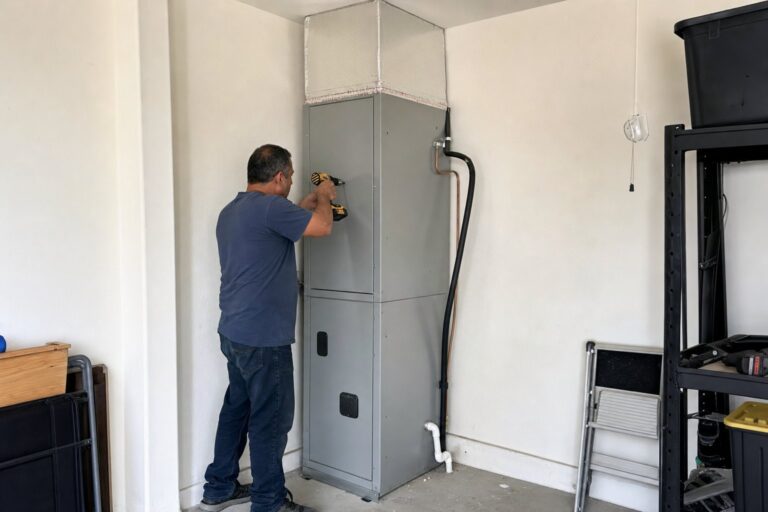
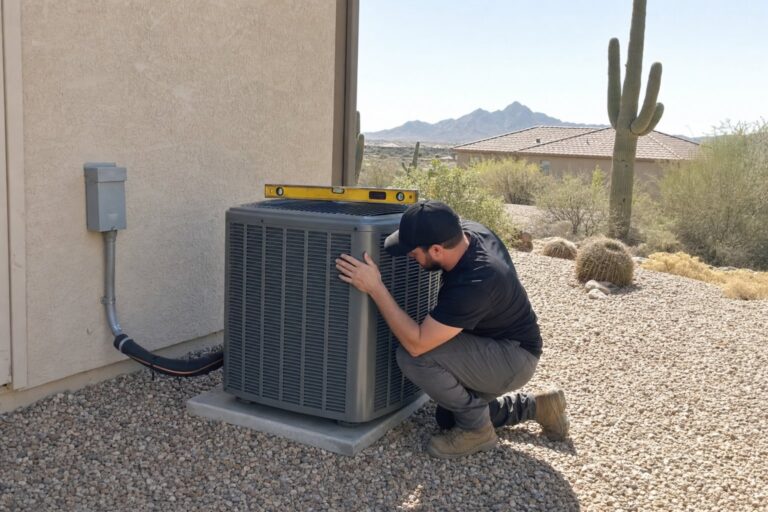
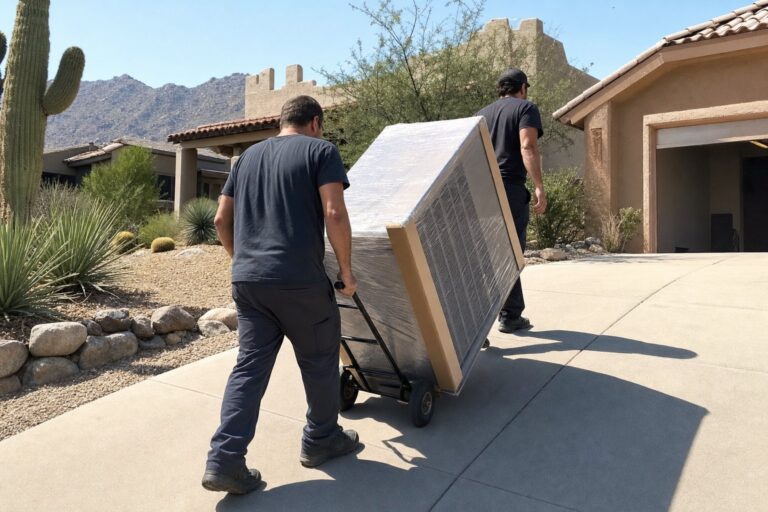
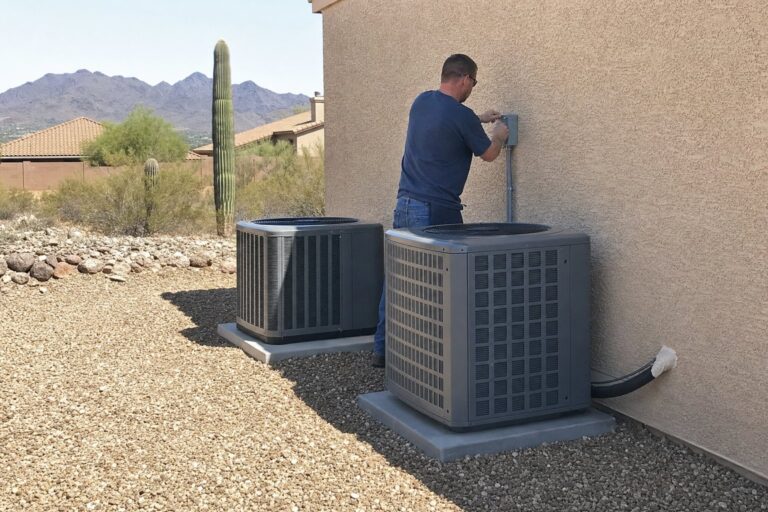
Air conditioning, heating, and cooler work at homes across the Phoenix metro.
How the job typically runs.
You hear the assessment fee when you book — stated plainly, and credited into the project price if we do the installation. Appointments hold their windows, and nobody arrives with a quota to hit.
The visit itself would satisfy an engineer, because in Chandler it often has to. We measure rather than eyeball: load calculation from the home's real dimensions and exposures, static pressure readings on the existing ductwork, a look at panel capacity, photographs of everything relevant. You see the evidence as it is gathered, and the numbers stay with you whether or not you hire us. The proposal that follows is flat-rate and written, typically laid out across two or three equipment tiers with the operating-cost logic of each explained against your SRP plan — no mystery line items, no price that grows once the drywall dust starts.
Installation follows a documented sequence, and commissioning is where we differ most from the volume shops: refrigerant charge verified against manufacturer tables, airflow confirmed, temperature splits and staging behavior recorded, thermostat configured properly for the equipment it controls. Every reading goes into a report you keep. If the upstairs-versus-downstairs balance was part of the project, we verify the delta actually closed instead of assuming it did. Afterward, the phone at (520) 556-8929 reaches a person around the clock — and the commissioning report means any future technician starts from facts, not folklore.
- 01 Booking, with the diagnostic fee disclosed
- 02 In-person diagnosis with real readings
- 03 Written flat-rate quote before work begins
- 04 The work: repair, install, or maintenance
- 05 Startup, documentation, and warranty handoff
Chandler requires a mechanical permit for heat pump replacements and new installations, and we treat that as our task from the first day: we file it under our own licenses, schedule the inspection, and attend it. If a project adds electrical scope — a new circuit for a conversion, a panel upgrade — the corresponding electrical permit rides along. No permit is needed for repairs, refrigerant service, or thermostat changes, so be wary of anyone padding an invoice with one. Two documents are worth knowing about as a Chandler homeowner. The first is the permit record itself, which follows the house and matters at resale, when buyers' inspectors in this market reliably check. The second is Arizona's Minimum Workmanship Standards, the statewide baseline every licensed contractor legally owes you. Read it if you enjoy knowing your rights; then note that our written labor warranty commits to more than that baseline, because meeting the legal minimum is table stakes, not a selling point. Inspection sign-off plus recorded commissioning data means your file on the project is complete.
Pricing, financing & the 10% military & first responder discount.
Our quotes are flat-rate and final before work begins — a discipline that matters in a city where entire streets are shopping for replacements in the same season and the door-knocker outfits know it. The evaluation fee disclosed at booking is applied to the installation when you proceed, so the assessment is effectively free to homeowners who move forward. We normally present multiple equipment tiers with the cost logic of each spelled out, because a spreadsheet-minded Chandler buyer deserves to see exactly where the money goes and what the efficiency delta returns on an SRP plan. Financing is available when spreading the investment out makes better household math than paying at once; we explain terms and step back. Active-duty military and veterans keep 10 percent through our military discount, every day, from a company that is veteran-owned itself. Utility incentives and the federal 25C credit get verified against current rules at quote time — we spec qualifying equipment when it genuinely pays and file the paperwork for you, and we decline to advertise dollar amounts that may be stale by the time you read them.
- 01 Flat-rate written quote after an in-person look
- 02 Diagnostic fee disclosed at booking, credited to the repair
- 03 Financing available on replacements
- 04 2-year workmanship warranty; 1-year manufacturer parts warranty
- 05 10% military, veteran & first responder discount
Why a licensed HVAC contractor matters.
FAQs: Heat Pump Installation in Chandler, AZ.
Why did our builder-grade system die at thirteen years when neighbors' units are failing too?
Because your street's systems were all born together, from the same bid sheet. Boom-era Chandler builders installed minimum-cost, single-stage equipment sized by shortcut and connected to ductwork routed for construction speed — a package with a natural lifespan of twelve to fifteen Arizona summers. When the failures start clustering on a street, that is the cohort aging out on schedule, not bad luck. The upside: your replacement can fix what the builder skipped — right-sizing, duct corrections, staged equipment — so the second system outlasts and outperforms the first by design.
Our upstairs runs hot every summer evening — can a new installation actually fix that?
Yes, if the installer treats it as an engineering problem instead of a thermostat complaint. The typical Chandler two-story loses the battle through attic-heated duct runs, weak return-air paths, and a single-stage system that cannot run gently for long stretches. During replacement we model the fix options: zoning dampers with independent control, a variable-speed system that sustains low continuous airflow, duct sealing or resizing, or a combination. Then commissioning verifies the result with before-and-after temperature readings, floor by floor. Fixing this at replacement costs a fraction of retrofitting it later.
Will you actually share the commissioning readings with us?
Gladly — it is standard practice on every installation we do, and Chandler is the city where clients most often ask up front. You receive the recorded numbers: static pressure, temperature splits across the coil, subcooling and superheat against manufacturer targets, strip-heat and defrost staging checks, and the thermostat configuration as programmed. Two reasons this matters beyond transparency: it proves the system was dialed in rather than merely powered on, and it gives any future technician a factual baseline, which shortens every diagnosis for the life of the equipment.
What do SEER2 and HSPF2 actually mean for an SRP bill?
SEER2 measures cooling efficiency, HSPF2 measures heating efficiency, and both come from updated federal test procedures that better reflect real ductwork. In Chandler, SEER2 dominates the money conversation because cooling drives most of your annual usage — a higher number means fewer kilowatt-hours for the same comfort across a seven-month season. HSPF2 matters less here but is not nothing, since winter mornings still call for heat. On SRP time-of-use plans, higher-efficiency variable-speed equipment also softens your on-peak draw, which is where those plans charge the most.
Half our neighborhood seems to be replacing systems this year — when should we schedule?
Before yours forces the decision, ideally. Chandler's subdivision cohorts fail in clusters, and the pattern is brutal: units limp through spring, then die in the first hundred-degree stretch when every contractor's board is full and equipment allocation gets tight. A system past its twelfth year showing symptoms — rising bills, longer runtimes, repair visits stacking up — is a candidate for planned replacement in the shoulder seasons, when scheduling is calm and you can make tier decisions deliberately instead of desperately during an outage in July.
How should we compare competing installation bids?
Insist that every bidder shows their inputs. When collecting quotes for heat pump installation, Chandler AZ homeowners should require three artifacts in writing: the load calculation with its assumptions, the exact equipment model numbers with SEER2 ratings, and the commissioning process that proves the finished work. A bid that is just tonnage and a price means the contractor guessed the size and plans to skip verification. Also confirm permit handling is included. Price differences between honest bids usually trace to equipment tier and duct scope — differences you can evaluate — rather than to magic.
Every major brand, serviced and installed.





Phoenix metro: Most days a tech is already working somewhere in the Valley, so same-day appointments happen when the schedule allows. After-hours emergencies are dispatched when a licensed tech is available — a real person answers and tells you the ETA on the call.
Call (520) 556-8929Request an estimate.
No pressure, no door knockers. We look at the HVAC system, tell you what it needs (and what it doesn’t), and put the number in writing.
Need heat pump installation in Chandler? A real person answers.
Other services we run in Chandler.
Heat Pump Installation in nearby cities.
Looking for something else nearby? All HVAC services in Chandler