
Chandler
Duct Sealing in Chandler, AZ.
- (520) 556-8929
- Serving the entire Phoenix metro — we come to you
- Office: Mon–Fri 8:00 AM – 5:00 PM · 24/7 emergency service
- 2-year workmanship warranty · 1-year parts warranty
- Veteran-owned & operated · residential + commercial
- 23 five-star Google reviews
The complaint we hear most in Chandler is a staircase. Downstairs holds temperature fine; upstairs runs five to eight degrees hotter every afternoon, and the family has quietly surrendered the bonus room by July. The reflex is to assume the air conditioner is undersized or dying, and in a tech-corridor city full of engineers and analysts, homeowners often arrive with spreadsheets of thermostat logs to prove it. Frequently the equipment is fine. The heat upstairs is duct leakage: supply air lost into a 140-degree attic before it ever reaches the second floor, and returns pulling that superheated attic air back into the system. When the ducts feeding the second story leak, no new condenser fixes the staircase; only sealing does. That distinction, equipment versus distribution, is the whole point of duct sealing in Chandler, AZ, and it is one you settle with measurements, not opinions. Chandler's 1990s and 2000s subdivisions were built in waves, so whole neighborhoods are aging into duct problems on the same timeline, their builder-grade systems reaching the end of the line at twelve to fifteen years and their ductwork leaking the entire way. So the same warm-upstairs complaint tends to surface across a whole subdivision within a summer or two of one another, house after house. Yeti Pros tests the ductwork, shows you the readings, seals what leaks, and re-tests to prove it, exactly the evidence a data-literate homeowner wants. Veteran-owned and operated, licensed under Arizona ROC #363372 and ROC #363423, we quote flat-rate in writing and work around SRP time-of-use rates. A real person answers (520) 556-8929 anytime, military and veteran families take 10 percent off, and the service-call fee is disclosed at booking and credited toward the repair.
ZIPs served: 85224, 85225, 85226, 85248, 85249
What Duct Sealing covers in Chandler.
Leakage & Static Pressure Diagnostics
We pressurize the duct system with a calibrated fan and read static pressure at the air handler, turning your leakage into a measured figure and flagging the restrictions that starve upstairs airflow. For the data-minded Chandler homeowner, this is the number that settles whether a warm second floor is an equipment problem or a duct problem.
Hand-Sealing With Mastic
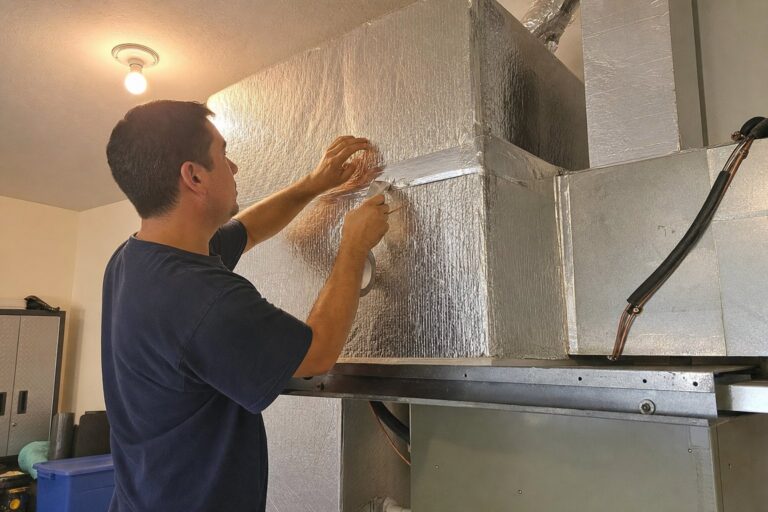
Every reachable leak, plenum seams, takeoff collars, boot connections, and the return platform, gets brushed with mesh-reinforced mastic, the durable standard that outlasts builder-grade tape. In Chandler's 1990s and 2000s tract homes this is where value-engineered connections that have leaked since install day finally get sealed, especially the upstairs supply takeoffs feeding the second floor.
Aerosolized Interior Sealing
For leaks buried under insulation or scattered along the long attic runs that feed upstairs bedrooms, we inject an aerosolized sealant into the pressurized ductwork; escaping air carries particles to each gap and seals it while the leakage number drops on screen. On sprawling Ocotillo floor plans it reaches leakage no hand can get to.
Attic Duct Insulation Upgrades
Sealing stops leaks; insulation stops heat gain, and on long upstairs runs both matter. A tight duct in thin, compressed insulation still delivers air degrees warmer than the coil made it, felt hardest on the second floor. While we are already in the attic we upgrade thin or torn insulation on the runs baking closest to the Chandler roofline.
Return-Air Corrections
Return leaks drag 140-degree attic air and dust into the system, and in two-story homes a starved or leaky upstairs return is a direct cause of second-floor heat. We seal return platforms, close cavity-built returns, and correct undersized returns choking the blower. Fixing the return side is often the missing half of a two-story comfort complaint.
Post-Seal Verification Readings
We re-test after sealing rather than declare victory. Registers come off, the ducts are pressurized again, and the new leakage figure is recorded beside the original. For a Chandler homeowner who arrived with thermostat logs, this closing measurement proves the upstairs branch now holds the air it should, documented on paper you keep and can compare next summer.
What we see for duct sealing in Chandler.
Chandler's defining pattern is the two-story comfort gap, and the attic is where it gets explained. In subdivisions across Ocotillo, Fulton Ranch, and the neighborhoods off Dobson and Ray, second-floor supply runs branch far across the attic to reach upstairs bedrooms, and every foot of that run is a chance to leak into the hottest space in the house. We routinely find takeoff collars pulled loose, flex sagging and separated at connections, and boots gapped from the ceiling, all of it bleeding the exact air that was supposed to cool the upstairs. When we put a manometer and a leakage number in front of a homeowner who arrived certain their AC was too small, the conversation changes fast. That single shift from opinion to measurement usually turns a comfort argument into a clear plan.
The second pattern is the subdivision built in a single wave. Chandler grew in tract phases through the nineties and 2000s, so a street's worth of homes carries the same builder-grade equipment and the same duct construction, installed the same year by the same crews. That means they age together. When one neighbor's system starts failing at twelve to fifteen years, the rest of the block is usually close behind, and the ductwork that was value-engineered on install day has been quietly leaking the whole time underneath. On one street we have tested three homes in a week and found the same failures repeating.
The upscale lake communities around Ocotillo add a wrinkle. Larger two-story floor plans mean longer duct runs, more zoning, and higher expectations, so a leaky upstairs branch is both more common and more noticed. Across all of Chandler, the homeowners tend to be measurement-minded, which suits us: we do not ask anyone to feel a difference. People here usually do not want a sales story; they want clear numbers and room to decide for themselves. We show static pressure, we show the leakage figure, and we show the same numbers again after sealing, and the evidence does the persuading.
- 01 Airflow and static pressure
- 02 Electrical: capacitors, contactors, draws
- 03 Refrigerant-circuit behavior
- 04 Drains, safeties, and float switches
- 05 Thermostat, controls, and cycling
- 06 Ducts, returns, and room-by-room comfort
Residential HVAC across the Valley.
Air conditioning, heating, and cooler work at homes across the Phoenix metro.
How the job typically runs.
The fee comes first, in plain numbers: you know the service-call charge before booking, and if sealing follows, that charge is credited toward it. From there the visit is built around showing you evidence, because Chandler homeowners want to see the readings, not hear conclusions handed down. We narrate the diagnosis as we go, so you understand what each number means before any quote appears.
We start at the air handler with static pressure, then walk the accessible ductwork, then run a pressurization test that assigns your leakage an actual figure. For a two-story home we pay particular attention to the upstairs supply branches where the comfort complaint lives. You see the numbers as we take them and the failures we found on the attic walk, then you get a flat-rate written quote, a firm figure that will not creep once the work starts. Nothing proceeds without your sign-off, and if the ducts are genuinely too degraded to seal, we tell you plainly rather than bill you to seal a lost cause.
After approved work we re-test, and the leakage number has to fall, or the job is not done. You leave with documented before-and-after readings you can file next to your own thermostat logs. For a household that came in with a spreadsheet, that closing measurement is the part that matters most, and it is the part too many contractors quietly skip.
- 01 Booking, with the diagnostic fee disclosed
- 02 In-person diagnosis with real readings
- 03 Written flat-rate quote before work begins
- 04 The work: repair, install, or maintenance
- 05 Startup, documentation, and warranty handoff
Sealing existing ducts in Chandler does not require a city permit. Mastic on seams, aerosol sealant, a return correction, or a better connection is repair of an existing system, not new construction, so there is no plan review and no inspector at the door. Permits apply when the scope changes the system: replacing the air handler or furnace, running new duct that alters the design, or new electrical all require a City of Chandler mechanical permit, which we pull and see through inspection, keeping the paperwork our responsibility.
For Chandler's two-story homes, one note comes up often. Adding zoning to fix an upstairs-comfort problem is a bigger scope than sealing and may be permitted work; sealing the existing ducts usually is not, and we tell you which category your fix falls into before we start.
Every task follows Arizona's Minimum Workmanship Standards, the ROC's legal baseline for licensed work. We treat that baseline as a floor, not a target: our written warranty on parts and workmanship exceeds what the state requires, and refrigerant work is performed only by EPA 608-certified technicians.
Pricing, financing & the 10% military & first responder discount.
Chandler homeowners tend to check the math, so we give them math to check. There is no blind duct-sealing price, because the honest figure depends on what the test measures and which methods your leakage calls for. After diagnosis you get a flat-rate written quote, a single firm number that holds from quote to invoice, and the service-call fee you already paid is credited toward the work. You approve a real number against a real leakage reading, not a vague estimate. We do not run cheap teaser inspections meant to manufacture alarming findings; the diagnosis is priced honestly because it is not a sales funnel. You can take the written quote, sit on it, or decline it, with no pressure or expiring-today gimmick. When sealing pairs with an insulation upgrade or larger duct work, financing options exist so a two-story comfort fix does not have to be one cash decision, and monthly terms keep it manageable. Active-duty military and veteran families claim their 10 percent through our military discount, a standing salute from a veteran-owned company, taken straight off the flat-rate total.
- 01 Flat-rate written quote after an in-person look
- 02 Diagnostic fee disclosed at booking, credited to the repair
- 03 Financing available on replacements
- 04 2-year workmanship warranty; 1-year manufacturer parts warranty
- 05 10% military, veteran & first responder discount
Why a licensed HVAC contractor matters.
FAQs: Duct Sealing in Chandler, AZ.
Why is my upstairs so much hotter than downstairs?
In Chandler two-story homes, the usual culprit is not an undersized AC but the ducts feeding the second floor. Those supply runs travel far across a 140-degree attic, and where they leak, cooled air escapes before reaching upstairs bedrooms while returns pull hot attic air back in. The result is a stubborn second-floor heat gap. A leakage test tells you exactly how much air the upstairs branch is losing, so you can seal the actual problem instead of replacing equipment that was never the cause.
Can you show me the actual readings?
Absolutely, and we prefer to. We take static pressure at the air handler and run a pressurization test that puts a hard number on your leakage, and you see those figures as we record them, not summarized afterward. Once sealing is done we re-test and show you the new numbers beside the originals. Plenty of Chandler homeowners come to us with their own thermostat data; we are happy to add our before-and-after leakage measurements to it, so the decision rests on evidence, not a technician's word.
What does duct sealing in Chandler, AZ cost?
It depends on what the test finds and which sealing methods your leakage requires, so we never quote blind. After diagnosis you receive a flat-rate written number, disclosed before any work starts, and the service-call fee already paid is credited toward it. Financing is available on larger two-story jobs, and military and veteran households take 10 percent off. The figure you approve against your measured leakage is the figure on the invoice, with no drift, which is the kind of straight math Chandler homeowners appreciate.
My whole neighborhood was built at once. Is that why systems are failing together?
Yes, that is exactly why. Chandler grew in tract phases through the nineties and 2000s, so a street of homes shares the same builder-grade equipment and duct construction, installed the same year. They wear on the same clock, which is why systems on a block often start failing around twelve to fifteen years, close together. The ductwork was value-engineered and has leaked ever since. If neighbors are replacing systems, it is a strong sign your ducts deserve the same test, and likely the same fix.
The house re-dusts within a day. Is that related to the ducts?
Very likely. Fast-returning dust is a classic sign of return-side leakage, where the system pulls unfiltered attic air, laced with insulation fibers and desert dust, into the supply stream and pushes it through the house. Chandler's tract homes frequently have returns built from open framing cavities that were never sealed. We test for it, seal the return side, and the dust load typically drops. If the ducts have leaked for years, pairing sealing with a one-time duct cleaning clears out what has already accumulated inside.
Is it worth sealing if my builder-grade system is near replacement?
It often is, and the timing shapes the answer. If replacement is a year or two out, sealing still returns lost air and eases a struggling system through the summers in between, and the test documents whether your existing ducts are even worth keeping. If replacement is imminent, we would rather seal during the install, when the plenum is already open and the crew is on site. Either way, connecting a new efficient system to ducts leaking a quarter of their output wastes the upgrade you paid for.
Every major brand, serviced and installed.





Phoenix metro: Most days a tech is already working somewhere in the Valley, so same-day appointments happen when the schedule allows. After-hours emergencies are dispatched when a licensed tech is available — a real person answers and tells you the ETA on the call.
Call (520) 556-8929Request an estimate.
No pressure, no door knockers. We look at the HVAC system, tell you what it needs (and what it doesn’t), and put the number in writing.
Need duct sealing in Chandler? A real person answers.
Other services we run in Chandler.
Duct Sealing in nearby cities.
Looking for something else nearby? All HVAC services in Chandler